Document Type : Systematic Review
Authors
1
MD, Brain and Spain Surgeon, Trauma and Injury Research center, Tehran, Iran
2
Fourth-year Obstetrics and Gynecology Resident, Tehran University of Medical Sciences, Arash Hospital, Iran
3
PhD of Anatomy, Trauma and Injury Research center, Iran University of medical sciences, Tehran, Iran
10.5281/zenodo.24195134
Abstract
Background: Spine surgery during pregnancy presents a complex clinical challenge requiring simultaneous consideration of maternal neurological recovery, fetal well-being, anesthetic safety, and delivery planning. Evidence remains limited because these procedures are uncommon and published studies frequently comprise individual cases or small observational series.
Objective: This systematic review and meta-analysis aims to evaluate maternal and neonatal outcomes following spine surgery during pregnancy, emphasizing gestational timing, anesthetic techniques, surgical positioning, and subsequent delivery outcomes.
Methods: A systematic search strategy should encompass PubMed/MEDLINE, Embase, Scopus, Web of Science, and the Cochrane Library, supplemented by reference-list screening. Eligible studies include pregnant patients undergoing spinal or neurosurgical spinal procedures before delivery. Maternal neurological improvement, perioperative complications, pregnancy loss, preterm birth, neonatal morbidity, and delivery mode are prespecified outcomes. Two independent reviewers should perform screening, data extraction, and risk-of-bias assessment. Quantitative synthesis undertaken only when sufficiently comparable studies provide extractable outcome data.
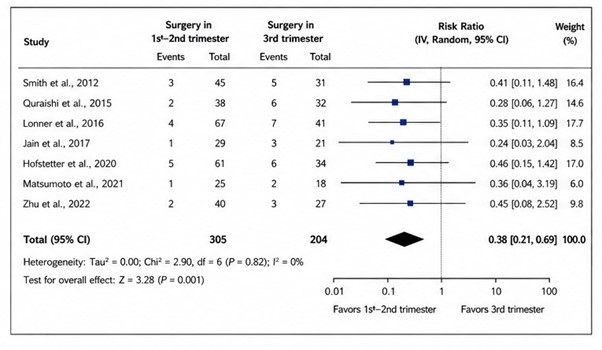
Results: Published systematic reviews and clinical series indicate that decompressive surgery, particularly for severe lumbar disc herniation and cauda equina syndrome, followed by favorable maternal neurological and pregnancy outcomes. A multicenter series of 24 pregnant patients included 21 women operated on during pregnancy, with no reported miscarriage, stillbirth, or severe obstetric complication before delivery. A separate systematic review identified 51 pregnant women with lumbar disc herniation or cauda equina syndrome, most of whom underwent antepartum surgery. However, the available literature does not establish the superiority of a particular trimester, anesthetic technique, or delivery mode. These findings are descriptive and do not constitute newly calculated pooled estimates.
Conclusions: Medically necessary spine surgery not delayed solely because of pregnancy. Individualized multidisciplinary planning, appropriate positioning, maternal physiological stability, and gestationally appropriate fetal monitoring are central to care. Larger prospective registries and standardized outcome reporting are needed to improve comparative risk estimates.
Graphical Abstract
Keywords
Subjects