Evaluation of Late-Onset Sarcopenia Following Radiotherapy in Mastectomy Patients

Document Type : Original Article

Authors

1 Assistant Professor of Thoracic Surgery, Department of Cardiovascular Surgery, School of Medicine, Tabriz University of Medical Sciences, Tabriz, Iran

2 Assistant Professor of Radiotherapy, Department of Radiology, School of Medicine, Tabriz University of Medical Sciences, , Tabriz, Iran

10.5281/zenodo.24192927)
Abstract
Introduction: Post-mastectomy radiation therapy is crucial for breast cancer management, yet its long-term impact on skeletal muscle depletion remains poorly understood. Because thoracic irradiation can provoke systemic catabolic pathways and progressive muscle loss, identifying secondary body composition changes is clinically vital. Therefore, this study was designed to evaluate the incidence of sarcopenia following radiotherapy in mastectomy patients.

Material and methods: This descriptive cross-sectional study evaluated 125 post-mastectomy patients recruited via convenience sampling at Shahid Madani Hospital. Following institutional ethics approval, standardized clinical data, radiotherapy records, and sarcopenia assessments including handgrip strength and muscle mass metrics were collected. Data were analyzed using appropriate descriptive and inferential statistical methods to examine post-treatment muscle status.

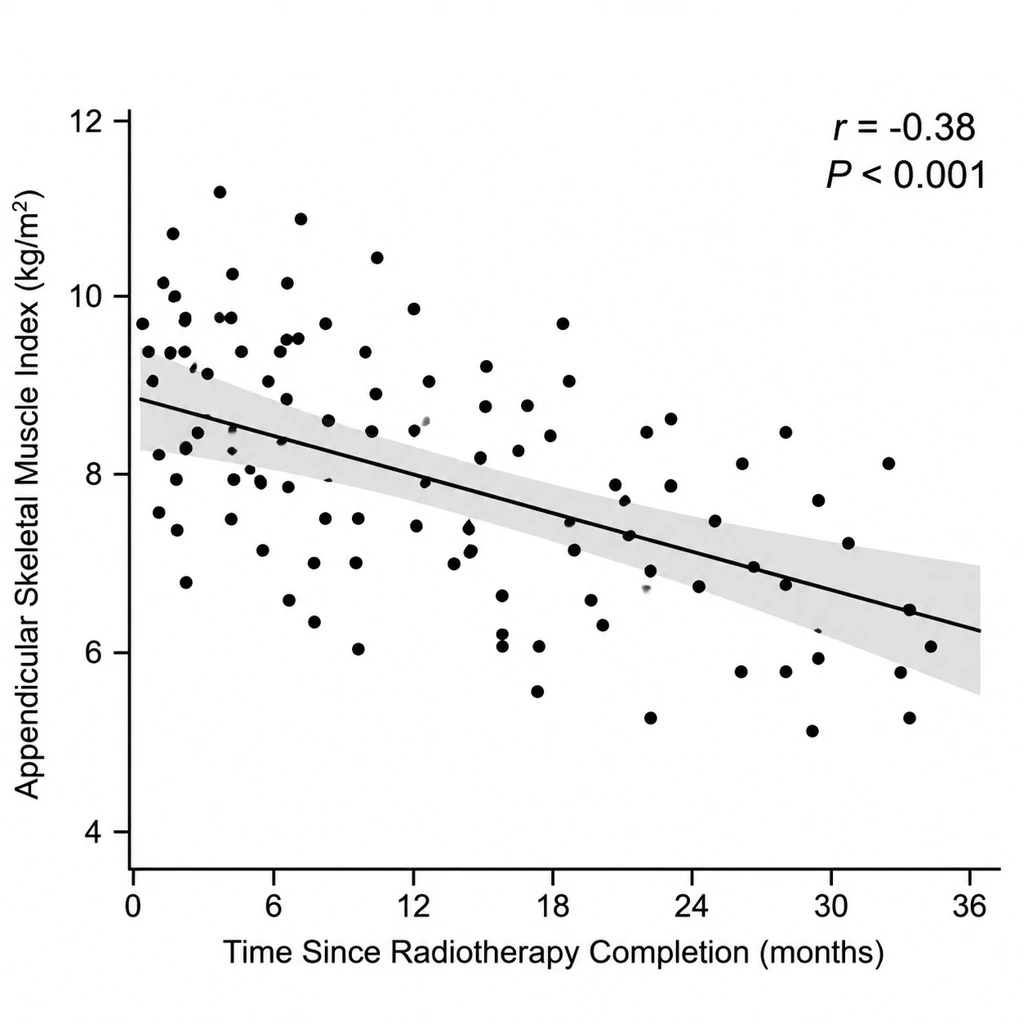
Results: In this cohort of 125 mastectomy patients, the overall prevalence of sarcopenia was 32.8% (n=41). Sarcopenic patients exhibited significantly lower appendicular skeletal muscle index (5.08±0.41 vs. 6.18±0.58 kg/m², P<0.001), reduced handgrip strength (14.4±2.5 vs. 20.8±3.7 kg, P<0.001), more extensive regional nodal irradiation (73.2% vs. 52.4%, P = 0.019), and a longer post-radiotherapy interval (9.2±4.3 vs. 6.5±3.2 months, P<0.001), with time showing a significant inverse correlation with muscle mass (r=-0.38, P<0.001).

Conclusion: Post-mastectomy radiotherapy, particularly comprehensive regional nodal irradiation and extended post-treatment duration, is significantly associated with a high prevalence of sarcopenia and progressive skeletal muscle depletion. These findings underscore the critical clinical necessity for routine muscle mass screening and targeted rehabilitation protocols in survivors undergoing locoregional radiotherapy.
Graphical Abstract

Evaluation of Late-Onset Sarcopenia Following Radiotherapy in Mastectomy Patients

Keywords

Subjects

Introduction: Post-mastectomy radiation therapy is crucial for breast cancer management, yet its long-term impact on skeletal muscle depletion remains poorly understood. Because thoracic irradiation can provoke systemic catabolic pathways and progressive muscle loss, identifying secondary body composition changes is clinically vital. Therefore, this study was designed to evaluate the incidence of sarcopenia following radiotherapy in mastectomy patients.
Material and methods: This descriptive cross-sectional study evaluated 125 post-mastectomy patients recruited via convenience sampling at Shahid Madani Hospital. Following institutional ethics approval, standardized clinical data, radiotherapy records, and sarcopenia assessments including handgrip strength and muscle mass metrics were collected. Data were analyzed using appropriate descriptive and inferential statistical methods to examine post-treatment muscle status.
Results: In this cohort of 125 mastectomy patients, the overall prevalence of sarcopenia was 32.8% (n=41). Sarcopenic patients exhibited significantly lower appendicular skeletal muscle index (5.08±0.41 vs. 6.18±0.58 kg/m², P<0.001), reduced handgrip strength (14.4±2.5 vs. 20.8±3.7 kg, P<0.001), more extensive regional nodal irradiation (73.2% vs. 52.4%, P=0.019), and a longer post-radiotherapy interval (9.2±4.3 vs. 6.5±3.2 months, P<0.001), with time showing a significant inverse correlation with muscle mass (r=-0.38, P<0.001).
Conclusion: Post-mastectomy radiotherapy, particularly comprehensive regional nodal irradiation and extended post-treatment duration, is significantly associated with a high prevalence of sarcopenia and progressive skeletal muscle depletion. These findings underscore the critical clinical necessity for routine muscle mass screening and targeted rehabilitation protocols in survivors undergoing locoregional radiotherapy.