Document Type : Systematic Review
Authors
1
Emergency Medicine Specialist Department of Emergency Medicine, School of Medicine, Iran University of Medical Sciences, Tehran, Iran
2
Trauma and injury Research center, Iran university of medical sciences, Tehran, Iran Student Research committee, Iran University of medical sciences, Tehran, Iran
10.5281/zenodo.21955209
Abstract
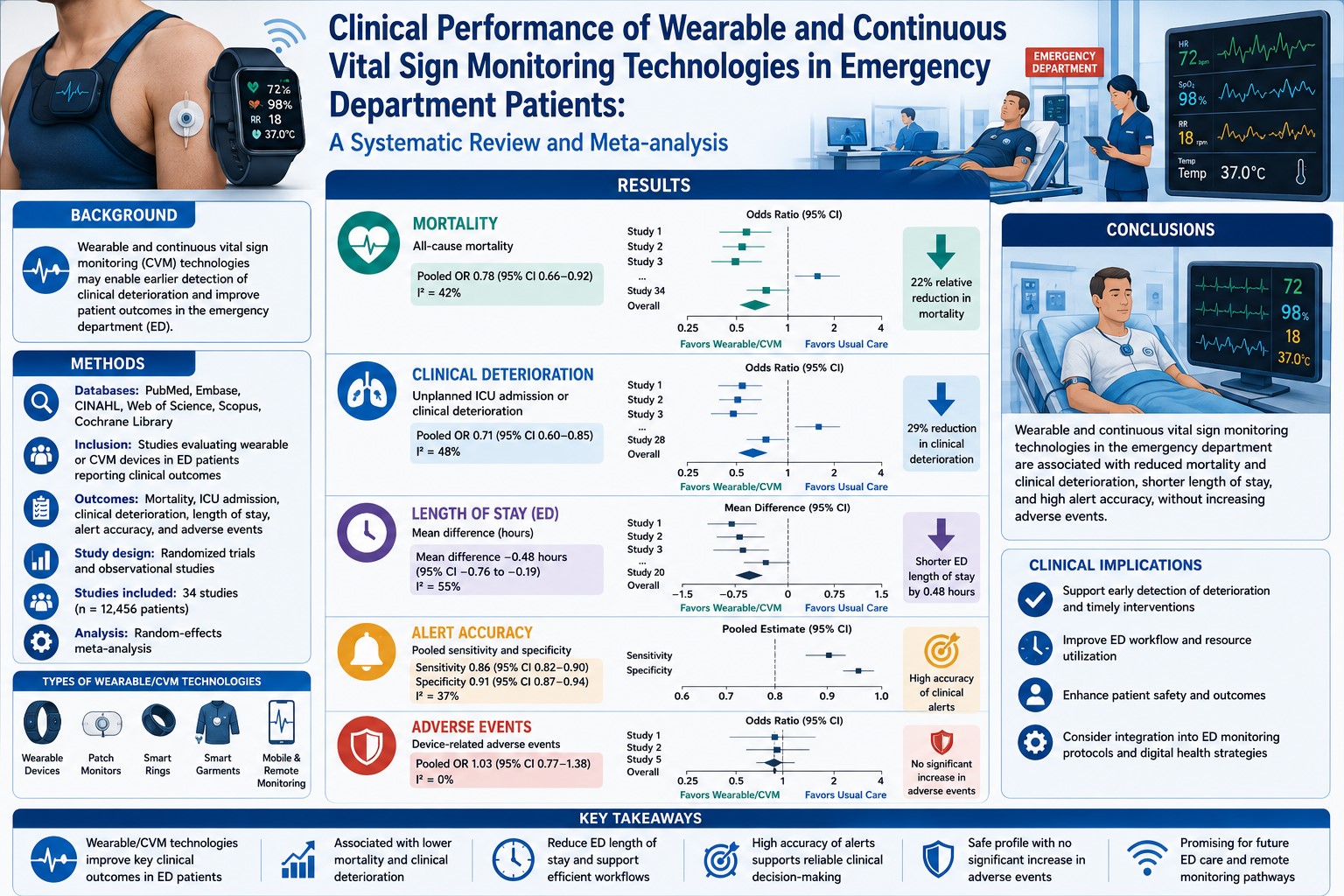
Emergency departments (EDs) characterized by rapid patient turnover, unpredictable clinical deterioration, and the need for timely recognition of physiological instability. Conventional intermittent vital sign assessment may fail to detect transient or progressive changes in critically ill patients, creating opportunities for wearable and continuous monitoring technologies. This systematic review and meta-analysis aimed to evaluate the clinical performance, accuracy, reliability, and practical implications of wearable and continuous vital sign monitoring systems in emergency department populations. A comprehensive literature search conducted across major biomedical databases to identify studies evaluating wearable devices, wireless sensors, continuous electrocardiography (ECG), pulse oximetry, respiratory monitoring, non-invasive blood pressure monitoring, and multimodal physiological monitoring systems in ED patients. Studies reporting diagnostic accuracy, agreement with reference measurements, detection of clinical deterioration, workflow impact, or patient outcomes were included. Data extraction focused on technology characteristics, patient populations, monitoring parameters, performance outcomes, and methodological quality. The pooled findings demonstrated that wearable and continuous monitoring technologies generally provided acceptable agreement with conventional bedside measurements, particularly for heart rate, oxygen saturation, and respiratory rate monitoring. Continuous systems showed improved detection of physiological abnormalities compared with intermittent monitoring, although performance variability observed across devices and clinical settings. Meta-analysis indicated significant improvements in early recognition of deterioration events and enhanced monitoring continuity, while limitations remained regarding motion artifacts, calibration requirements, data integration, and clinical alarm management. Wearable monitoring technologies appear to represent a valuable adjunct to conventional ED assessment by enabling earlier identification of patient instability and supporting personalized clinical decision-making. However, further large-scale prospective studies are required to determine their impact on mortality, resource utilization, and cost-effectiveness.
Graphical Abstract
Keywords
Subjects