Prevalence and Clinical Pattern of Radiation-Induced Cervicothoracic Musculoskeletal and Neurological Disorders in Breast Cancer Survivors: A Prospective Observational Study

Document Type : Original Article

Authors

1 Assistant Professor of Neurosurgery, Department of Neurosurgery, School of Medicine, Tabriz University of Medical Sciences, Tabriz, Iran

2 Assistant Professor of Radiotherapy, Department of Radiology, School of Medicine, Tabriz University of Medical Sciences, Tabriz, Iran

10.5281/zenodo.23863417
Abstract
Introduction: This prospective observational study investigates the prevalence and clinical patterns of radiation-induced cervicothoracic musculoskeletal and neurological disorders in breast cancer survivors. By systematically tracking these long-term morbidities following radiotherapy, the study aims to provide critical evidence to optimize screening protocols, improve supportive care pathways, and enhance the overall quality of life for this vulnerable patient population.

Material and methods: This descriptive cross-sectional study was conducted at Shahid Madani Hospital in Tabriz, Iran, and enrolled 175 breast cancer survivors through convenience sampling. The sample size was estimated using Cochran’s formula for prevalence studies. Trained clinicians collected demographic, cancer-treatment, and radiotherapy data and assessed cervicothoracic musculoskeletal symptoms, neurological complaints, and relevant examination findings using a standardized protocol.

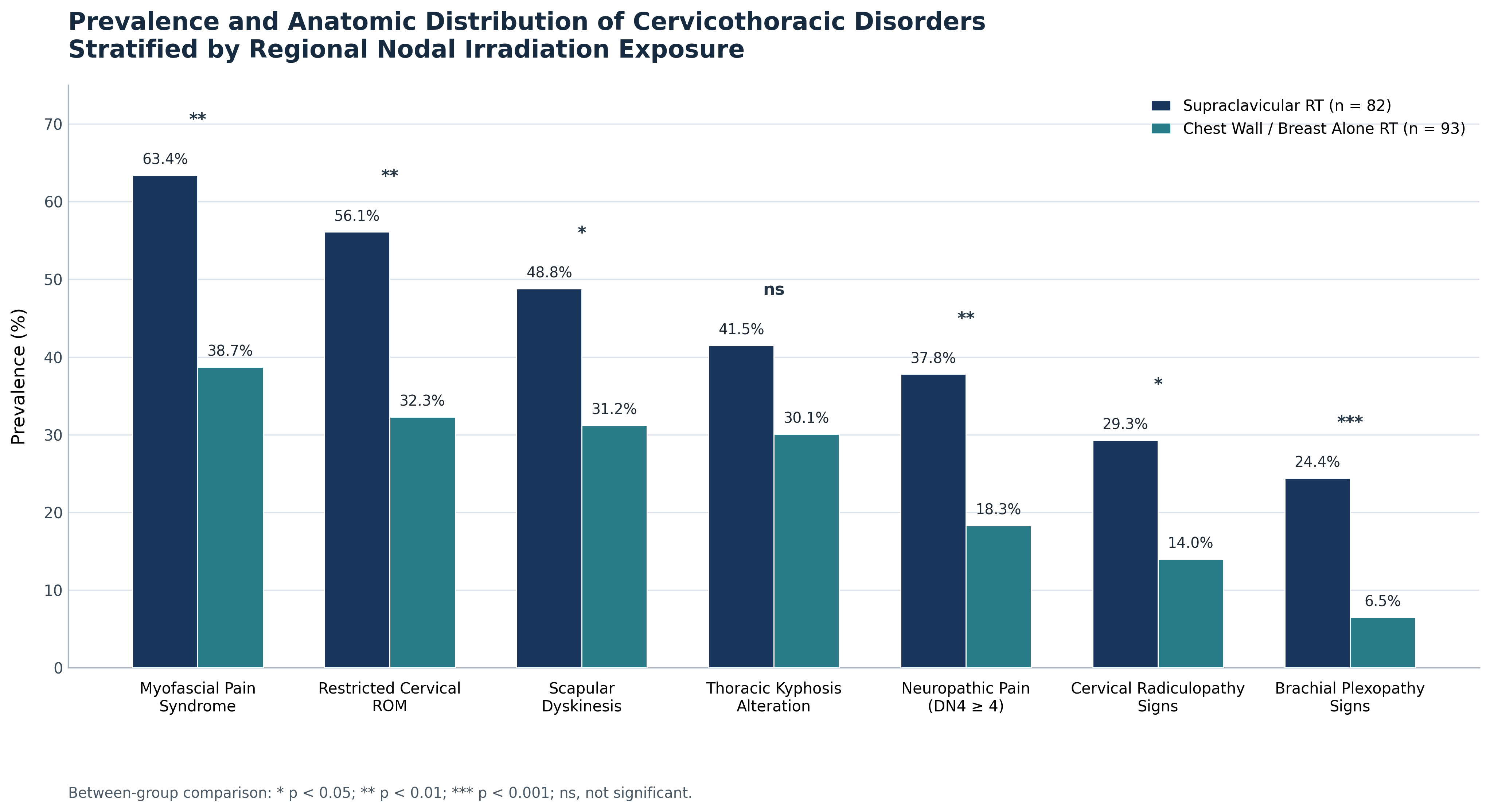
Results: Cervicothoracic musculoskeletal and neurological impairments were highly prevalent, predominantly manifesting as ipsilateral myofascial pain (50.3% [42.9-57.7]) and neuropathic pain (27.4% [21.1-34.6]). Multivariable analysis identified supraclavicular nodal irradiation (aOR = 2.18 [1.21-3.92], P = 0.009), axillary dissection (aOR = 1.74 [1.02-3.01], P = 0.042), and >12 months post-radiotherapy interval (aOR = 1.81 [1.01-3.25], P = 0.047) as independent risk factors (P<0.05).

Conclusion: Cervicothoracic musculoskeletal and neurological complications frequently afflict breast cancer survivors, showing strong independent associations with supraclavicular radiotherapy and axillary surgery. These findings underscore the imperative for targeted prospective screening and early rehabilitative interventions tailored to high-risk locoregional treatment profiles.

Graphical Abstract

Prevalence and Clinical Pattern of Radiation-Induced Cervicothoracic Musculoskeletal and Neurological Disorders in Breast Cancer Survivors: A Prospective Observational Study

Keywords

Subjects

[1]    Amsterdam, E. A., Wenger, N. K., Brindis, R. G., et al. (2014). 2014 AHA/ACC guideline for the management of patients with non-ST-elevation acute coronary syndromes. Circulation, 130(25), e344-e426.
[2]    Collet, J. P., Thiele, H., Barbato, E., et al. (2021). ESC Guidelines for acute coronary syndromes. European Heart Journal, 42(14), 1289-1367.
[3]       Hosseinpoor, S., & Yousef, R. M. (2027). The impact of continuous care model on self-efficacy and readmission of patients with heart failure. Eurasian Journal of Chemical, Medicinal and Petroleum Research, 6(1), 1–14.
[4]       Rahi, D., Ghotbi, N., Nosratabadi, R., Sayyari, M., & Sabzevari, B. (2023). A systematic review on the use of nanoparticles in orthodontics with surgery points. The Seybold Report, 18(6), 1542–1559.
[5]       Rahi, D., Abbassi, S., & Tajbakhsh, N. (2024). Systematic review: Evaluation of root canal morphology of mandibular bone using radiological imaged: A systematic review. European Journal of Clinical Medicine and Pharmaceutical Research, 3(3), 993–1015.
[6]       Rezai, M., Amiri, H., Delbari, D., Keshmiri, Y. S., Aghdam, H., Zohri, D., & Hesam, R. (2019). Comparison of intramuscular injection of ketorolac and conventional treatment in the field of cost-effectiveness, length of stay and pain relief in patients admitted to the emergency department with renal colic. Bali Medical Journal, 8(1), 83–87.
[7]       Hosseini Kasnavieh, S. M., Shaker, S. H., Milanifard, M., Hessam, R., & Ghadesi, M. (2026). Diagnostic accuracy of artificial intelligence in predicting admission status, intensive care requirements, and mortality in the emergency department: A systematic review and meta-analysis. Medical Journal of the Islamic Republic of Iran.
[8]       Rezai, M., Javdani Esfehani, K., Valipour, A. M., Hessam, R., Soleymani, N., Zarei Jelyani, N., & Javan, A. (2026). Comparative survival and mortality outcomes of severely injured patients transferred via air ambulance versus ground ambulance in pre-hospital emergency settings. European Journal of Scientific Research and Reviews, 4(1), 95–111.
[9]       Moghadam, A M. (2026). Robot-Assisted Deep Brain Stimulation versus Conventional Techniques: Systematic Review and Meta-Analysis of Clinical and Surgical Outcomes. Medicinal, Psychological, and Health Research Journal (MPHRJ), 2(2), 147-155.
[10]    Mehrasa, P and Eghdam Zamiri, R. (2026). Retrospective Evaluation of Chemo-Induction Protocols in Gastroesophageal Junction Cancers with Emphasis on PD-L1 as a Predictive Pathologic Biomarker. Medicinal, Psychological, and Health Research Journal (MPHRJ), 2(4), 276-284.
[11]    Sadeghzadeh, A. (2026). Evaluating the effectiveness and safety of hyaluronic acid versus poly-L-lactic acid for facial volume restoration: A Systematic Review and Meta-analysis. Journal of Advanced in Medicinal, Pharmaceutical and Biomedical Research (JAMPBR), 2(2), 102-113.
[12]    Motaqi, M, Afrand, M and Ghanjal, A. (2022). Care and Management of Pain in Patients with Musculoskeletal Pain during the Covid-19 Epidemic. International Journal of Musculoskeletal Pain Prevention, 7(1), 622-626.
[13]    Motaqi, M , Ghanjal, A and Afrand, M . (2022). Treadmill Exercise and its Effect on Rehabilitation of Patients after Ischemic strok: A Narrative Study. International Journal of Musculoskeletal Pain Prevention, 7(3), 730-740.
[14]    Motaqi, M , Samadi, M , Ghanjal, A and Afrand, M . (2022). A New Approach to Evaluate of Musculoskeletal Pain. International Journal of Musculoskeletal Pain Prevention, 7(4), 781-787.
[15]    Moghadam, A. M., Yousef, R. M., Azizi, R., Hessam, R. & Milanifard, M. (2026). Anesthetic and Perioperative Predictors of Neurological Deterioration and Mortality Following Emergency Craniotomy for Acute Brain Injury: A Systematic Review and Meta-Analysis. Journal of Advanced in Medicinal, Pharmaceutical and Biomedical Research (JAMPBR), 2(6), 551-564.
[16]    Moghadam, A. M., Yousef, R. M., Azizi, R., Hessam, R. & Milanifard, M. (2026). Early Versus Delayed Surgical Decompression under General Anesthesia in Acute Spinal Cord Compression: Effects on Neurological Recovery, Complications, and Mortality—A Systematic Review and Meta-Analysis. Journal of Advanced in Medicinal, Pharmaceutical and Biomedical Research (JAMPBR), 2(6), 537-550.
[17]     Neishaboury, M., Shokri, S., Kianpour, P., Farhadi, K., Najjari, K., Sharifnia, H., Mohammad Yousef, R., & Khajavi, M. (2025). The effects of intraperitoneal dexmedetomidine in comparison with ropivacaine in postoperative pain after laparoscopic sleeve gastrectomy: A double-blind, randomized, placebo-controlled, clinical trial. Obesity Surgery, 35(6), 2150–2159.
[18]    Afrand, M., Rostampur, N., Pourhadi, Z., Rezanezhad, J., & Nekoueifard, P. (2025). Epilepsy in children with central nervous system infections: A systematic review and meta-analysis. AFMN Biomedicine, 42(4), 450–455.
[19]    Samimi, A. (2025). Assessment of Risks Arising from Neuropsychological Crises in Cardiac Patients Using FMEA. Journal of Advanced in Medicinal, Pharmaceutical and Biomedical Research (JAMPBR), 1(7), 196-203.
[20]    Samimi, A. (2025). Risk Assessment in Hospitals Using the FMEA Method: A Data-Driven Analysis for Patient Safety Improvement. Journal of Advanced in Medicinal, Pharmaceutical and Biomedical Research (JAMPBR), 1(6), 180-187.

Articles in Press, Accepted Manuscript
Available Online from 01 November 2026