The Pathologic Role of Preoperative Albumin-to-C-Reactive Protein Ratio in Detecting Early Acute Infection Following Femur Implant Insertion

Document Type : Original Article

Authors

1 Associate Professor of Pathology, Department of Pathology, School of Medicine, Tabriz University of Medical Sciences, Tabriz, Iran

2 Associate Professor of Orthopaedics, Department of Orthopedics, School of Medicine, Tabriz University of Medical Sciences, Tabriz, Iran

10.5281/zenodo.23165331
Abstract
Introduction: Implant-associated infections after femur surgery are severe, and early diagnosis is challenging due to overlapping postoperative inflammation. While CRP and albumin are commonly used markers, their combined ratio may offer better insight into host reserve and inflammatory burden. This study aims to assess the preoperative albumin-to-C-reactive protein ratio for detecting early acute infection following femur implant insertion.

Material and methods: This descriptive cross-sectional study at Shohada Hospital, Tabriz, enrolled 85 patients undergoing femoral implant surgery using convenience sampling. Preoperative data on demographics, comorbidities, surgical details, and laboratory markers (including serum albumin and CRP to calculate the Alb/CRP ratio) were collected to assess early acute postoperative infection.

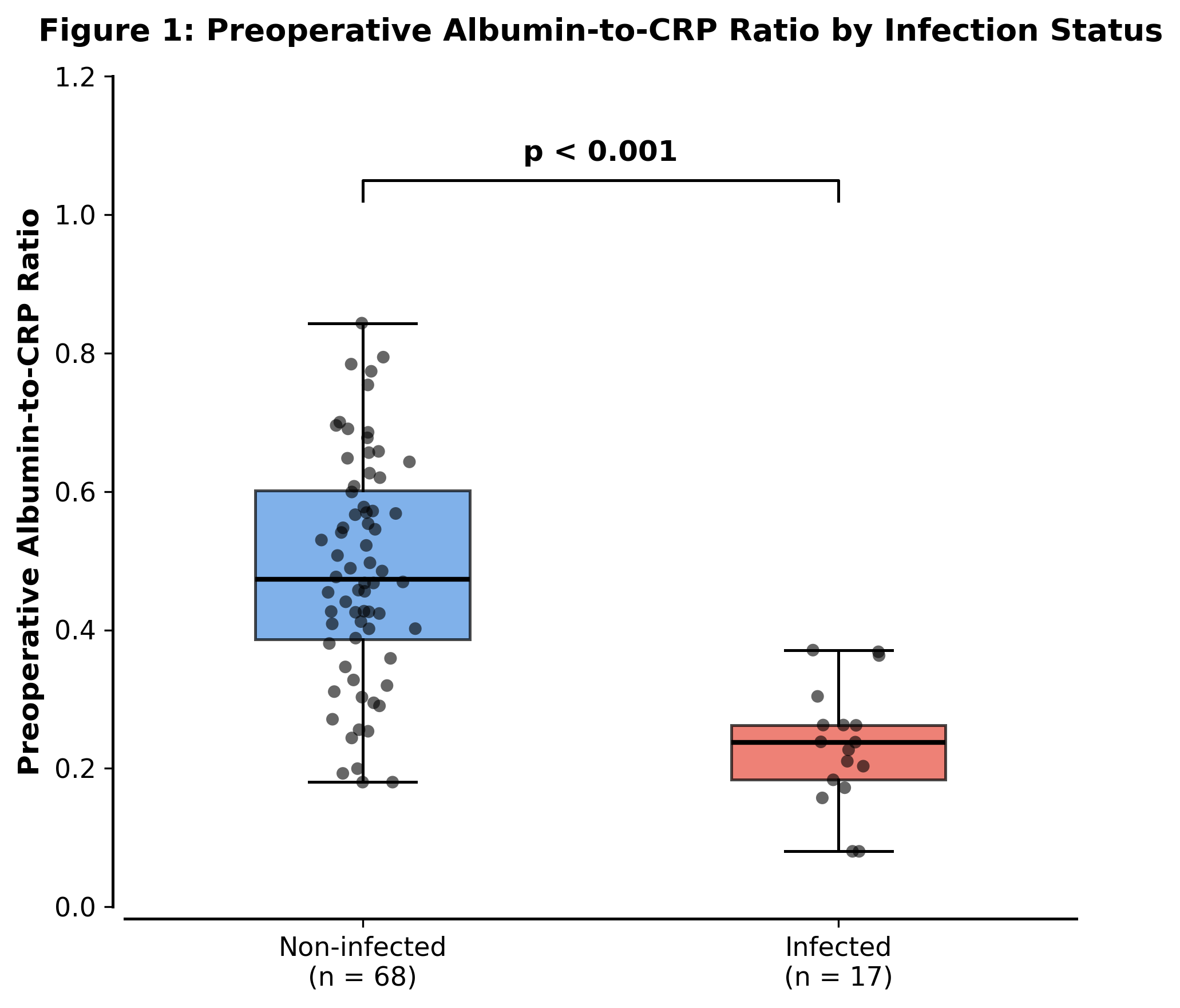
Results: Preoperative albumin-to-C-reactive protein ratio was significantly suppressed in infected patients compared with non-infected controls [median 0.22 (IQR 0.15–0.30) vs. 0.50 (IQR 0.36–0.68); p < 0.001]. Receiver operating characteristic analysis established superior discriminatory performance for Alb/CRP (AUC = 0.988; 95% CI: 0.82–0.98; cutoff ≤ 0.34; sensitivity 100.0%, specificity 95.6%). Multivariable logistic regression identified Alb/CRP ≤ 0.34 as an independent predictor of early acute infection (aOR = 9.10; 95% CI: 3.20–25.80; p < 0.001) alongside operative duration ≥ 120 minutes (aOR = 2.45; p = 0.028).

Conclusion: Preoperative albumin-to-C-reactive protein ratio serves as an outstanding, independent biomarker for early acute infection risk stratification following femur implant placement.

Graphical Abstract

The Pathologic Role of Preoperative Albumin-to-C-Reactive Protein Ratio in Detecting Early Acute Infection Following Femur Implant Insertion

Keywords

Subjects

[1]       Salomão, R., Ferreira, B. L., Salomão, M. C., Santos, S. S., Azevedo, L. C. P., & Brunialti, M. K. C. (2019). Sepsis: Evolving concepts and challenges. Brazilian Journal of Medical and Biological Research, 52, e8595.
[2]       Duncan, C. F., Youngstein, T., Kirrane, M. D., & Lonsdale, D. O. (2021). Diagnostic challenges in sepsis. Current Infectious Disease Reports, 23, Article 22.
[3]       Tarján, D., Szalai, E., Lipp, M., et al. (2024). Persistently high procalcitonin and C-reactive protein are good predictors of infection in acute necrotizing pancreatitis: A systematic review and meta-analysis. International Journal of Molecular Sciences, 25(2), 1273.
[4]       Sproston, N. R., & Ashworth, J. J. (2018). Role of C-reactive protein at sites of inflammation and infection. Frontiers in Immunology, 9, 754.
[5]        
[6]       Gregoriano, C., Heilmann, E., Molitor, A., & Schuetz, P. (2020). Role of procalcitonin use in the management of sepsis. Journal of Thoracic Disease, 12(Suppl. 1), S5–S15.
[7]       Shiferaw, B., Bekele, E., Kumar, K., Boutin, A., & Frieri, M. (2016). The role of procalcitonin as a biomarker in sepsis. Journal of Infectious Diseases and Epidemiology, 2, Article 23937.
[8]       Schupp, T., Weidner, K., Rusnak, J., et al. (2024). C-reactive protein and procalcitonin during course of sepsis and septic shock. Irish Journal of Medical Science, 193, 457–468.
[9]       Downes, K. J., Fitzgerald, J. C., & Weiss, S. L. (2020). Utility of procalcitonin as a biomarker for sepsis in children. Journal of Clinical Microbiology, 58(11), e01851-19.
[10]    Nargis, W., Ibrahim, M., & Ahamed, B. U. (2014). Procalcitonin versus C-reactive protein: Usefulness as biomarker of sepsis in ICU patient. International Journal of Critical Illness and Injury Science, 4(3), 195–199.
[12]    Li, M., Qin, Y. J., Zhang, X. L., et al. (2024). A biomarker panel of C-reactive protein, procalcitonin and serum amyloid A is a predictor of sepsis in severe trauma patients. Scientific Reports, 14, 628.
[14]    Hassan, J., Khan, S., Zahra, R., Razaq, A., Zain, A., Razaq, L., & Razaq, M. (2022). Role of procalcitonin and C-reactive protein as predictors of sepsis and in managing sepsis in postoperative patients: A systematic review. Cureus, 14(10), e31067.
[15]    Jiang, X., Zhang, C., Pan, Y., Cheng, X., & Zhang, W. (2023). Effects of C-reactive protein trajectories of critically ill patients with sepsis on in-hospital mortality rate. Scientific Reports, 13, 15223.
[16]    Suberviola, B., Castellanos-Ortega, A., González-Castro, A., García-Astudillo, L. A., & Fernández-Miret, B. (2012). Prognostic value of procalcitonin, C-reactive protein and leukocytes in septic shock. Medicina Intensiva (English Edition), 36(3), 177–184.
[17]    Meyer, Z. C., Schreinemakers, J. M. J., Mulder, P. G. H., de Waal, R. A., Ermens, A. A. M., & van der Laan, L. (2013). The role of C-reactive protein and the SOFA score as parameters for clinical decision making in surgical patients during the intensive care unit course. PLoS ONE, 8(5), e55964.
[18]    Castelli, G. P., Pognani, C., Cita, M., Stuani, A., Sgarbi, L., & Paladini, R. (2006). Procalcitonin, C-reactive protein, white blood cells and SOFA score in ICU: Diagnosis and monitoring of sepsis. Minerva Anestesiologica, 72(1–2), 69–80. X
[19]    Kim, I. Y., Kim, S., Ye, B. M., Kim, M. J., Kim, S. R., Lee, D. W., & Lee, S. B. (2022). Procalcitonin decrease predicts survival and recovery from dialysis at 28 days in patients with sepsis-induced acute kidney injury receiving continuous renal replacement therapy. PLoS ONE, 17(12), e0279561.