Document Type : Original Article
Authors
1
Associate Professor of Pathology, Department of Pathology, School of Medicine, Tabriz University of Medical Sciences, Tabriz, Iran
2
Associate Professor of Orthopaedics, Department of Orthopedics, School of Medicine, Tabriz University of Medical Sciences, Tabriz, Iran
10.5281/zenodo.23161435
Abstract
Introduction: Older adults undergoing major emergency orthopedic surgery face high risks of postoperative delirium (POD), a debilitating complication. Inflammation and stress, reflected by the neutrophil-to-lymphocyte ratio (NLR), may contribute to POD. This study evaluates NLR as a predictor of POD in this vulnerable cohort.
Material and methods: This study employed a descriptive cross-sectional design at Shohada Hospital, Tabriz, Iran, with 88 elderly patients undergoing major emergency orthopedic surgery. Convenience sampling and Cochran’s formula determined sample size. Inclusion criteria focused on age (≥65), surgery type, preoperative CBC availability, and post-op assessment capability, while excluding pre-existing cognitive impairment or confounding conditions. Data on demographics, clinical factors, and NLR were collected, with postoperative delirium as the primary outcome.
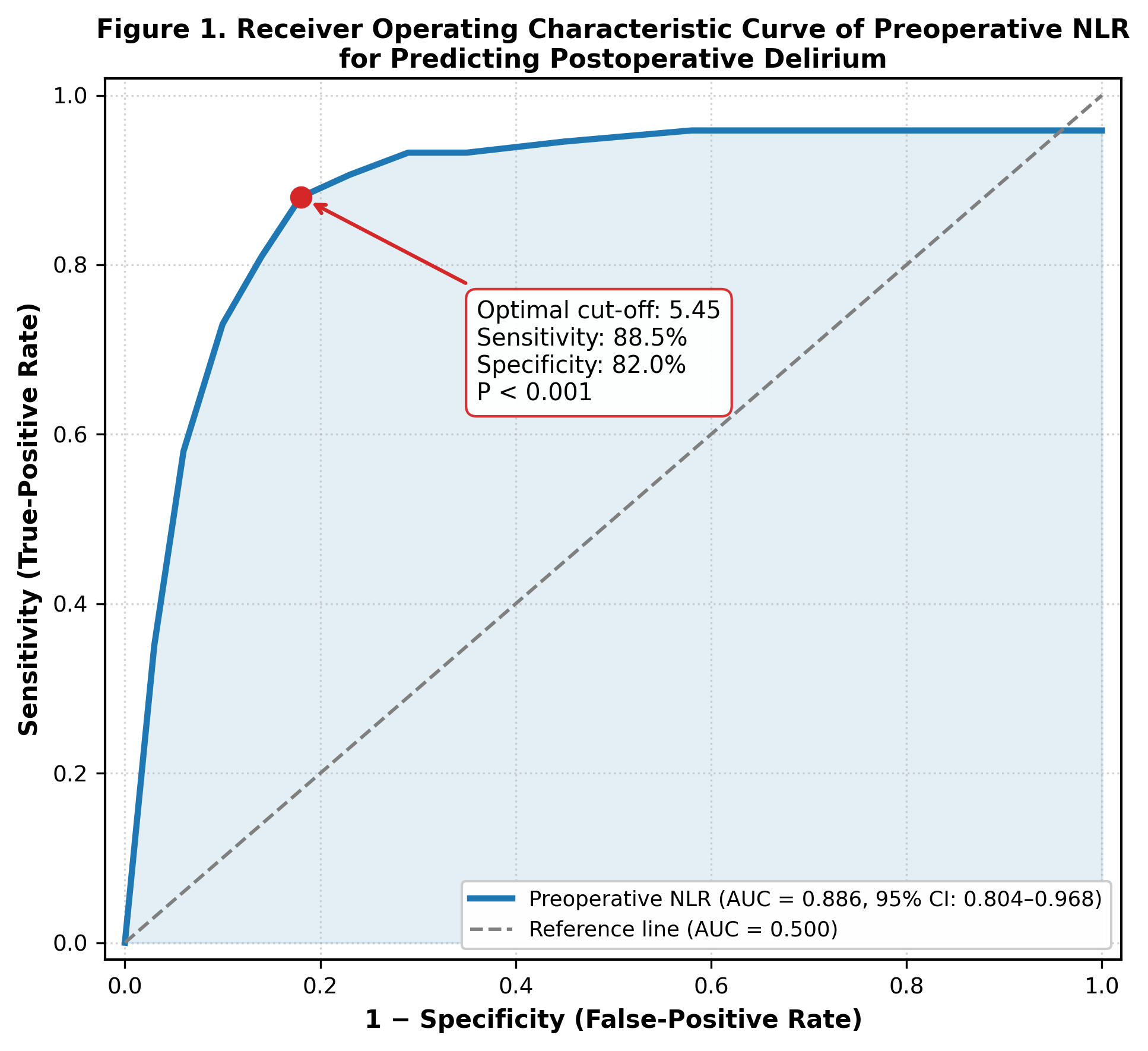
Results: A total of 88 patients were evaluated, with 26 (29.5%) developing postoperative delirium. Advanced age (P < 0.001), higher ASA status (P = 0.007), longer surgery (P = 0.018) and delay times (P = 0.005), lower albumin (P = 0.001), and elevated NLR (P < 0.001) were associated with delirium. Preoperative NLR (OR = 1.89, 95% CI: 1.29-2.77, P = 0.001) independently predicted delirium.
Conclusion: Preoperative NLR is a significant independent predictor of postoperative delirium in elderly patients undergoing major orthopedic surgery, suggesting its utility in risk stratification and early intervention strategies for this vulnerable population.
Graphical Abstract
Keywords
Subjects