Predictive Value of the Systemic Immune-Inflammation Index for Acute Postoperative Complications in Elderly Patients Undergoing Femoral Fracture Surgery

Document Type : Original Article

Authors

1 Associate Professor of Pathology, Department of Pathology, School of Medicine, Tabriz University of Medical Sciences, Tabriz, Iran

2 Associate Professor of Orthopaedics, Department of Orthopedics, School of Medicine, Tabriz University of Medical Sciences, Tabriz, Iran

10.5281/zenodo.23168058
Abstract
Introduction: Geriatric femoral fractures frequently precipitate severe acute postoperative complications, yet early risk stratification remains suboptimal. Given the potential of systemic inflammatory markers to reflect perioperative stress, identifying reliable biomarkers is clinically critical. Therefore, this study aimed to evaluate the predictive value of the systemic immune-inflammation index for acute postoperative complications in elderly patients undergoing femoral fracture surgery.

Material and methods: This descriptive cross-sectional study at Shohada Hospital, Tabriz, enrolled 118 elderly patients with femoral fractures, determined by Cochran’s formula. Preoperative systemic immune-inflammation index (SII) values were calculated from complete blood counts. Participants were prospectively evaluated to assess the association between admission SII and acute postoperative complications, with statistical models utilized to determine the index’s prognostic accuracy in predicting adverse surgical outcomes.

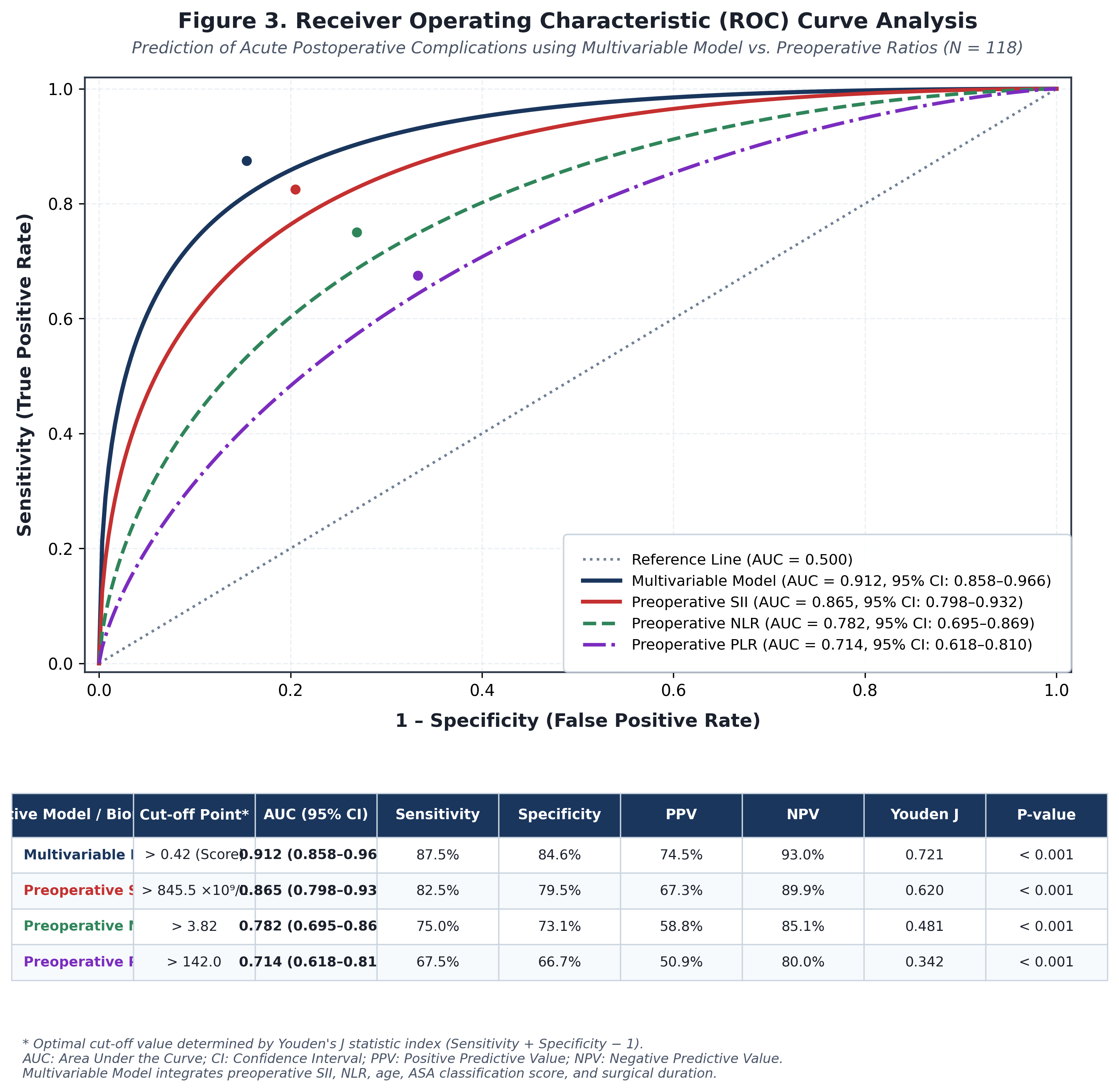
Results: This study comprehensively analyzed preoperative inflammatory biomarkers for predicting acute postoperative complications in elderly patients with femoral fractures. Key findings indicate that elevated SII (AUC=0.865), NLR (AUC=0.782), and PLR (AUC=0.714) are significantly associated with increased complication risk. The multivariable model demonstrated superior predictive accuracy (AUC=0.912), highlighting the clinical utility of these indices for early risk stratification and tailored perioperative management.

Conclusion: Preoperative assessment of systemic inflammatory indices, particularly SII, offers valuable insights into the risk of acute postoperative complications in elderly hip fracture patients, enabling targeted interventions for improved outcomes.

Graphical Abstract

Predictive Value of the Systemic Immune-Inflammation Index for Acute Postoperative Complications in Elderly Patients Undergoing Femoral Fracture Surgery

Keywords

Subjects

[1]       Luo, F., Zhou, X.-L., Li, J.-J., & Hui, R.-T. (2009). Inflammatory response is associated with aortic dissection. Ageing Research Reviews, 8(1), 31–35.
[2]       Yu, W., Liang, Y., Gao, J., & Xiong, J. (2024). Study on risk factors and treatment strategies of hypoxemia after acute type A aortic dissection surgery. Journal of Cardiothoracic Surgery, 19, Article 273.
[3]       Stephens, R. S., Shah, A. S., & Whitman, G. J. R. (2013). Lung injury and acute respiratory distress syndrome after cardiac surgery. The Annals of Thoracic Surgery, 95(3), 1122–1129.
[4]       Levy, J. H., & Tanaka, K. A. (2003). Inflammatory response to cardiopulmonary bypass. The Annals of Thoracic Surgery, 75(2), S715–S720.
[5]       Asimakopoulos, G., Smith, P. L. C., Ranatunga, C. P., & Taylor, K. M. (1999). Lung injury and acute respiratory distress syndrome after cardiopulmonary bypass. The Annals of Thoracic Surgery, 68(3), 1107–1115.
[6]       McCallister, J. W., Adkins, E. J., & O’Brien, J. M. (2009). Obesity and acute lung injury. Clinics in Chest Medicine, 30(3), 495–508.
[7]       Engelmann, B., & Massberg, S. (2013). Thrombosis as an intravascular effector of innate immunity. Nature Reviews Immunology, 13(1), 34–45.
[8]       Maugeri, N., Campana, L., Gavina, M., et al. (2014). Activated platelets present high mobility group box 1 to neutrophils, inducing autophagy and promoting the extrusion of neutrophil extracellular traps. Journal of Thrombosis and Haemostasis, 12(12), 2074–2088.
[9]       Caudrillier, A., Kessenbrock, K., Gilliss, B. M., et al. (2012). Platelets induce neutrophil extracellular traps in transfusion-related acute lung injury. Journal of Clinical Investigation, 122(7), 2661–2671.
[10]    Hotchkiss, R. S., Monneret, G., & Payen, D. (2013). Sepsis-induced immunosuppression: From cellular dysfunctions to immunotherapy. Nature Reviews Immunology, 13(12), 862–874.
[11]    Hu, B., Yang, X.-R., Xu, Y., Sun, Y.-F., Sun, C., Guo, W., Zhang, X., Wang, W.-M., Qiu, S.-J., Zhou, J., & Fan, J. (2014). Systemic immune-inflammation index predicts prognosis of patients after curative resection for hepatocellular carcinoma. Clinical Cancer Research, 20(23), 6212–6222.
[12]    Yoon, J., Jung, J., Ahn, Y., & Oh, J. (2021). Systemic immune-inflammation index predicted short-term outcomes in patients undergoing isolated tricuspid valve surgery. Journal of Clinical Medicine, 10(18), 4147.
[13]    Li, S., Lu, J., Cheng, W., Zhu, J., & Jin, M. (2019). Factors associated with low admission platelet count in adults with acute aortic dissection. Annals of Thoracic and Cardiovascular Surgery, 25(3), 142–148.
[14]    Von Elm, E., Altman, D. G., Egger, M., Pocock, S. J., Gøtzsche, P. C., Vandenbroucke, J. P., & STROBE Initiative. (2014). The Strengthening the Reporting of Observational Studies in Epidemiology (STROBE) statement: Guidelines for reporting observational studies. International Journal of Surgery, 12(12), 1495–1499.
[15]    Collins, G. S., Reitsma, J. B., Altman, D. G., & Moons, K. G. M. (2015). Transparent Reporting of a Multivariable Prediction Model for Individual Prognosis or Diagnosis (TRIPOD): The TRIPOD statement. Annals of Internal Medicine, 162(1), 55–63.
[16]    Abedini, N and Eslampoor, Y. (2026). Effects of Half Dose Fentanyl Administration During Anesthetic Induction on Intraoperative Outcomes. Medicinal, Psychological, and Health Research Journal (MPHRJ), 2(4), 306-316.
[17]    Abedini, N and Eslampoor, Y. (2026). Serum Creatinine Dynamics During the First 48 Hours After Major Surgery Following Intraoperative Diuretic Administration. Medicinal, Psychological, and Health Research Journal (MPHRJ), 2(4), 285-294.
[18]    Van Calster, B., McLernon, D. J., van Smeden, M., Wynants, L., & Steyerberg, E. W. (2019). Calibration: The Achilles heel of predictive analytics. BMC Medicine, 17, Article 230.
[19]    Van Calster, B., Nieboer, D., Vergouwe, Y., De Cock, B., Pencina, M. J., & Steyerberg, E. W. (2016). A calibration hierarchy for risk models was defined: From utopia to empirical data. Journal of Clinical Epidemiology, 74, 167–176.
[20]    Pencina, M. J., D’Agostino, R. B., Sr., D’Agostino, R. B., Jr., & Vasan, R. S. (2008). Evaluating the added predictive ability of a new marker: From area under the ROC curve to reclassification and beyond. Statistics in Medicine, 27(2), 157–172.
[21]    Gimbrone, M. A., Jr., & García-Cardeña, G. (2016). Endothelial cell dysfunction and the pathobiology of atherosclerosis. Circulation Research, 118(4), 620–636.
[22]    Luyendyk, J. P., Schoenecker, J. G., & Flick, M. J. (2019). The multifaceted role of fibrinogen in tissue injury and inflammation. Blood, 133(6), 511–520.
[23]    Hotamisligil, G. S. (2017). Inflammation, metaflammation and immunometabolic disorders. Nature, 542(7640), 177–185.