Effects of Surgical Anatomy Study Guide–Based Education on the Clinical Performance of Operating Room Students: Catheterization, Patient Transfer, Wound Closure, Instrument Handling, Positioning, and Hemostasis
1
Educator, Operating Room Technology Department, Alborz University of Medical Sciences, Karaj, Iran
2
MSc, Operating Room Technology Department, Alborz University of Medical Sciences, Karaj, Iran.
10.22034/mphrj.2026.597717.1113
Abstract
Introduction: Surgical anatomy underpins every core perioperative skill, yet operating room students often struggle to translate anatomical theory into clinical practice. Targeted study guides that integrate anatomy with procedural workflow may bridge this gap. This study aimed to determine the effects of surgical anatomy study guide–based education on the clinical performance of operating room students across catheterization, patient transfer, wound closure, instrument handling, positioning, and hemostasis.
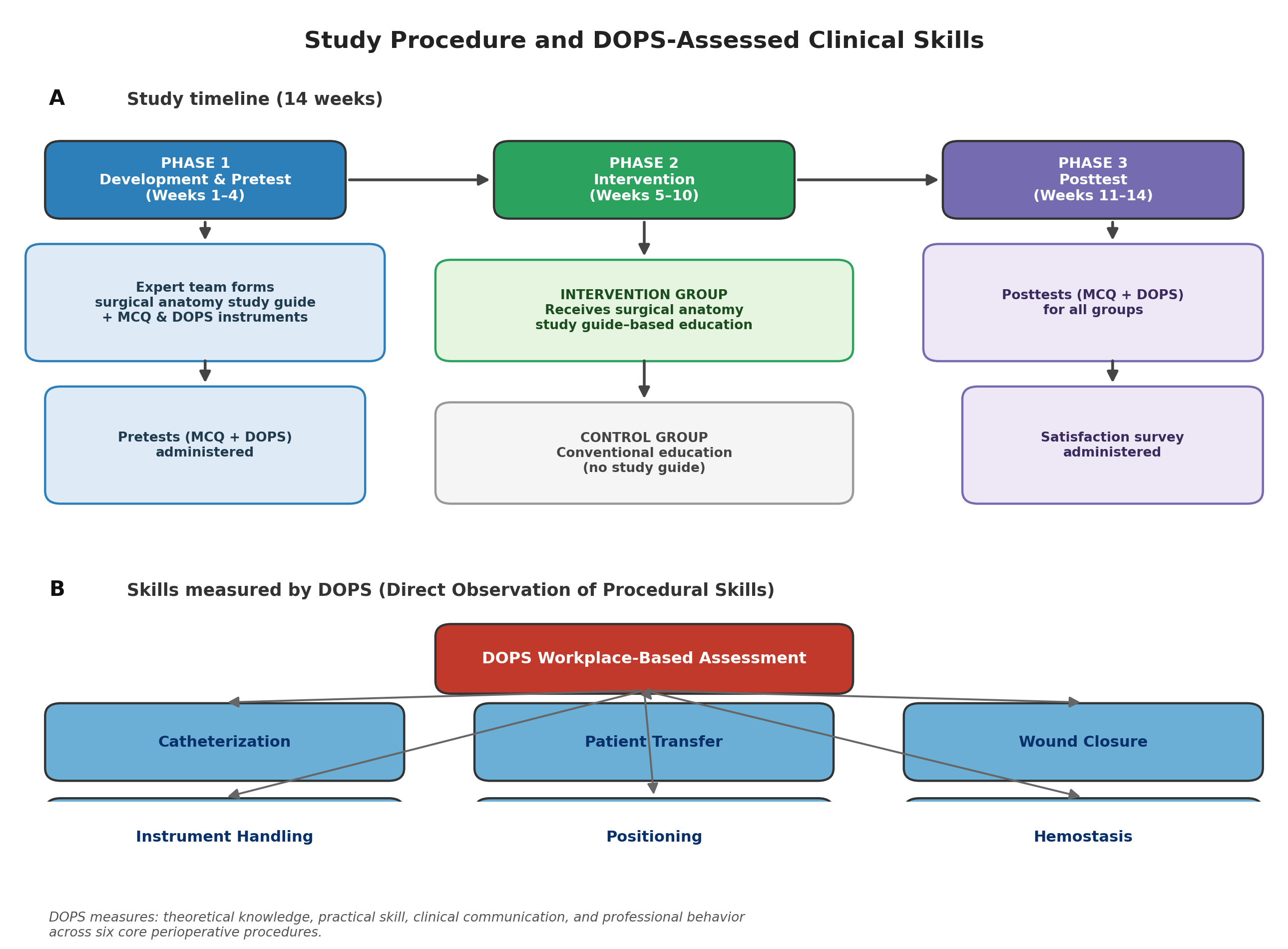
Material and methods: This quasi-experimental study with a Solomon four-group design included 60 undergraduate operating room students. Over fourteen weeks, the intervention groups received surgical anatomy study guide–based education while controls received conventional teaching. Six procedural skills were assessed before and after using Direct Observation of Procedural Skills (DOPS) and multiple-choice examinations.
Results: Direct observation and feedback times varied across skills, with wound closure requiring the longest observation (14.30 min) and patient transfer the shortest (5.02 min). DOPS scores increased across groups: control (280.91±49.72), control+pretest (319.09±39.30), intervention (359.33±84.13), and intervention+pretest (404.47±70.42). The intervention group scored significantly higher than controls (t = -3.62, df = 24, p < 0.001; mean difference = 85.38).
Conclusion: In conclusion, this study provides evidence that surgical anatomy study guide–based education significantly enhances the clinical performance of operating room technology students across six core perioperative skills, with the greatest benefits observed when the intervention is combined with pretesting.
Kohan,M and hazrati,S . (2026). Effects of Surgical Anatomy Study Guide–Based Education on the Clinical Performance of Operating Room Students: Catheterization, Patient Transfer, Wound Closure, Instrument Handling, Positioning, and Hemostasis. (e251132). Medicinal, Psychological, and Health Research Journal (MPHRJ), (), e251132 doi: 10.22034/mphrj.2026.597717.1113
MLA
Kohan,M , and hazrati,S . "Effects of Surgical Anatomy Study Guide–Based Education on the Clinical Performance of Operating Room Students: Catheterization, Patient Transfer, Wound Closure, Instrument Handling, Positioning, and Hemostasis" .e251132 , Medicinal, Psychological, and Health Research Journal (MPHRJ), , , 2026, e251132. doi: 10.22034/mphrj.2026.597717.1113
HARVARD
Kohan M, hazrati S. (2026). 'Effects of Surgical Anatomy Study Guide–Based Education on the Clinical Performance of Operating Room Students: Catheterization, Patient Transfer, Wound Closure, Instrument Handling, Positioning, and Hemostasis', Medicinal, Psychological, and Health Research Journal (MPHRJ), (), e251132. doi: 10.22034/mphrj.2026.597717.1113
CHICAGO
M Kohan and S hazrati, "Effects of Surgical Anatomy Study Guide–Based Education on the Clinical Performance of Operating Room Students: Catheterization, Patient Transfer, Wound Closure, Instrument Handling, Positioning, and Hemostasis," Medicinal, Psychological, and Health Research Journal (MPHRJ), (2026): e251132, doi: 10.22034/mphrj.2026.597717.1113
VANCOUVER
Kohan M, hazrati S. Effects of Surgical Anatomy Study Guide–Based Education on the Clinical Performance of Operating Room Students: Catheterization, Patient Transfer, Wound Closure, Instrument Handling, Positioning, and Hemostasis. Medicinal, Psychological, and Health Research Journal (MPHRJ). 2026;():e251132. doi: 10.22034/mphrj.2026.597717.1113