Designing a Surgical Anatomy Education Program for Surgical Technology Students

Document Type : Original Article

Authors

1 Educator, Operating Room Technology Department, Alborz University of Medical Sciences, Karaj, Iran

2 MSc, Operating Room Technology Department, Alborz University of Medical Sciences, Karaj, Iran.

10.5281/zenodo.22031025
Abstract
Introduction: Surgical technology students need anatomy teaching that is directly linked to operative practice, as traditional lecture-based methods often fail to prepare them for the demands of the operating room. A structured, learner-centered program may improve understanding, confidence, and clinical readiness. This study aimed to design a surgical anatomy education program for surgical technology students.

Material and methods: This educational study designed and validated a surgical anatomy program for surgical technology students through needs assessment, expert review, and structured content development. The program was then implemented using a planned instructional approach that linked anatomy to operating room practice. Outcomes were evaluated with appropriate instruments, and the study followed standard ethical principles, including informed consent, confidentiality, and ethics approval.

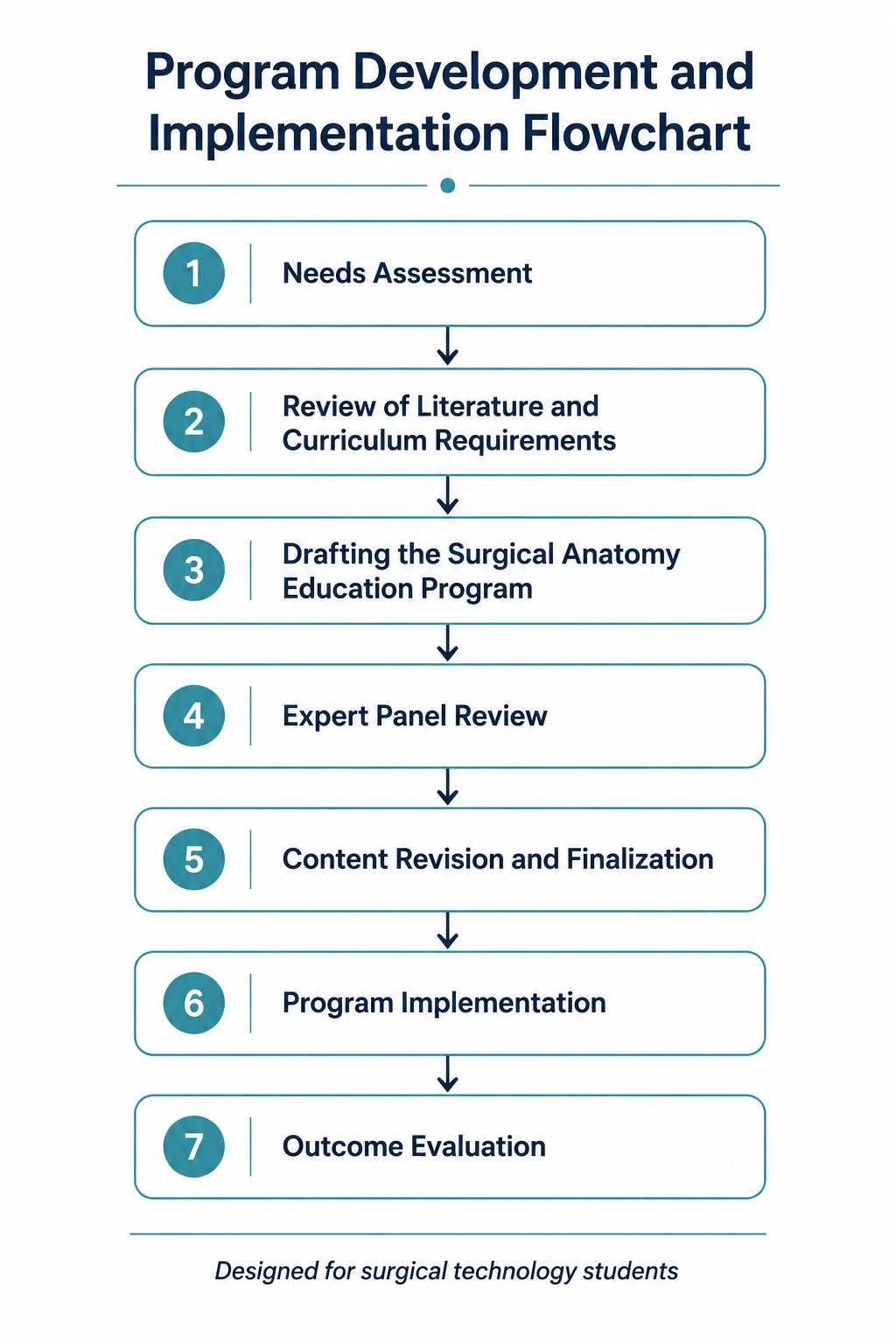
Results: The surgical anatomy education program showed strong expert endorsement and clear structural coherence, with high validity across most domains (overall CVI=0.97; mean content relevance = 4.70±0.41; mean clarity=4.69±0.44; mean necessity=4.75±0.41). The highest ratings were observed for program structure, core topics, procedural guidance, and layout (CVR=1.00; CVI=1.00), while self-assessment questions required the most revision (CVR=0.60; CVI=0.90). The development process was systematic and iterative, progressing from needs assessment to expert review, revision, implementation, and evaluation.

Conclusion: This study indicates that a carefully designed, expert-validated surgical anatomy program can provide a credible foundation for surgical technology education. Its strong content validity and clinically aligned structure suggest that it is suitable for implementation and may improve the relevance and quality of anatomy teaching in the operating room context.

Graphical Abstract

Designing a Surgical Anatomy Education Program for Surgical Technology Students

Keywords

Subjects

[1]       Zbuzant, M. (2026). Advances in Digital Dentistry Applications of CADCAM Technology. Journal of Advanced in Medicinal, Pharmaceutical and Biomedical Research (JAMPBR), 2(4), 346-358.
[2]       Rebout, F. (2026). The Relationship between Oral Health and Systemic Diseases: A Comprehensive Review of Bidirectional Linkages and Pathophysiological Mechanisms. Journal of Advanced in Medicinal, Pharmaceutical and Biomedical Research (JAMPBR), 2(4), 359-370.
[3]                Bawazeer, G., Sales, I., Allogamy, H., Balderdash, A., Mahmoud, M., Aljohani, M. A., et al. (2022). Crossword puzzle as a learning tool to enhance learning about anticoagulant therapeutics. BMC Medical Education, *22*, Article 267.
[4]       Rahmani, A and Abadi, P M S. (2026). Effectiveness of Skin Graft Fixation Techniques in Plastic Surgery: A Systematic Review and Meta-Analysis. Journal of Advanced in Medicinal, Pharmaceutical and Biomedical Research (JAMPBR), 2(4), 309-325.
[5]       salehitali, S , Hassanpour, A and Rahimi, K. (2026). The effectiveness of educational interventions based on the collaborative care model on treatment adherence in patients with chronic kidney failure undergoing hemodialysis: A clinical trial study. Journal of Advanced in Medicinal, Pharmaceutical and Biomedical Research (JAMPBR), 2(4), 326-331.
[6]       Rebout, F. (2026). The Impact of Oral Hygiene Practices on the Prevention of Periodontal Diseases. Journal of Advanced in Medicinal, Pharmaceutical and Biomedical Research (JAMPBR), 2(4), 332-345.
[7]                Eriksson, J., Lindgren, B. M., & Lindahl, E. (2020). Newly trained operating room nurses'' experiences of nursing care in the operating room. Scandinavian Journal of Caring Sciences, *34*(4), 1074–1082.
[8]       Zbuzant, M. (2026). Early Detection of Oral Cancer: Diagnostic Methods and Challenges. Journal of Advanced in Medicinal, Pharmaceutical and Biomedical Research (JAMPBR), 2(4), 371-382.
[9]                Ismail, M. A., Ahmad, A., Mohammad, J. A., Fakri, N. M., Nor, M. Z., & Pa, M. N. (2019). Using Kahoot! as a formative assessment tool in medical education: A phenomenological study. BMC Medical Education, *19*, Article 230.
[10]             Kalleny, N. K. (2020). Advantages of Kahoot! game-based formative assessments along with methods of its use and application during the COVID-19 pandemic in various live learning sessions. Journal of Microscopy and Ultrastructure, *8*(4), 175–185.
[11]             Khalafallah, F. G., & Alqaysi, R. (2021). Blending team-based learning and game-based learning in pharmacy education. Currents in Pharmacy Teaching and Learning, *13*(8), 992–997.
[12]             Khorammakan, R., Omid, A., Mirmohammadsadeghi, M., & Ghadami, A. (2023). Puzzle game-based learning: A new approach to promote learning of principles of coronary artery bypass graft surgery. BMC Medical Education, *23*, Article 241.
[13]    Sadeghzadeh, A. (2026). Parametric Design and Personalized Facial Reconstruction: Lessons from Contemporary Architecture. Journal of Advanced in Medicinal, Pharmaceutical and Biomedical Research (JAMPBR), 2(4), 296-308.
[14]             Matreja, P. S., Kaur, J., & Yadav, L. (2021). Acceptability of the use of crossword puzzles as an assessment method in Pharmacology. Journal of Advances in Medical Education & Professionalism, *9*(3), 154–159.
[15]             Moonaghi, H. K., Ahmady, S., Zardosht, R., & Razavi, M. E. (2020). Educational concern of surgical technology students in the operating room: A grounded theory study. Journal of Education and Health Promotion, *9*, Article 58.
[16]             Aghili,A and Najafi,S . (2026). Effectiveness of Antibiotic Prophylaxis in Preventing Postoperative Infection Following Total Knee Arthroplasty: A Systematic Review. Medicinal, Psychological, and Health Research Journal (MPHRJ), 2(6), 429-437.
[17]             Rehder, R., Abd-El-Barr, M., Hooten, K., Weinstock, P., Madsen, J. R., & Cohen, A. R. (2016). The role of simulation in neurosurgery. Child''s Nervous System, *32*(1), 43–54.
[18]             Sadati, L., Nafar, M., Karami, S., Yazdani, M. R., & Khaneghah, Z. N. (2021). Comparison of the effect of two teaching methods on surgical technologist students'' learning and satisfaction (flashcards vs. mobile-based learning). Journal of Education and Health Promotion, *10*, Article 467.
[19]             Samimi, A. (2025). Application of Failure Mode and Effects Analysis (FMEA) for Risk Management in Hospital Laboratories. Medicinal, Psychological, and Health Research Journal (MPHRJ), 1(5), 160-168.
[20]             Seyed Hoseini,S V and Nasseri,A R . (2026). Identification of Predictive Factors for Late Radiotherapy Induced Complications in Post Mastectomy Breast Cancer Survivors. Medicinal, Psychological, and Health Research Journal (MPHRJ), 2(6), 409-418.
[21]             Seyed Hoseini,S V and Nasseri,A R . (2026). Clinical Significance of Preoperative Serum Albumin Levels in Predicting Survival After Surgery in Patients Undergoing Colorectal Cancer Resection. Medicinal, Psychological, and Health Research Journal (MPHRJ), 2(6), 419-428.
[22]             Güngör,S . (2026). The Efficacy of Cognitive Behavioral Therapy (CBT) in Treating Treatment-Resistant Depression: Mechanisms and Long-Term Outcomes. Medicinal, Psychological, and Health Research Journal (MPHRJ), 2(6), 438-451.
[23]             Mokabber,N , Mokaber,M and Lotfi,A R . (2026). Effects of Dexmedetomidine on the Incidence of Agitation and Pain Severity after Traumatic Nasal Surgeries. Medicinal, Psychological, and Health Research Journal (MPHRJ), 2(6), 452-460.
[24]             Hessam,R and Milanifard,M . (2026). Clinical Performance of Wearable and Continuous Vital Sign Monitoring Technologies in Emergency Department Patients: A Systematic Review and Meta-analysis. Medicinal, Psychological, and Health Research Journal (MPHRJ), 2(6), 461-471.
[25]             Zamani, P., Haghighi, S. B., & Ravanbakhsh, M. (2021). The use of crossword puzzles as an educational tool. Journal of Advances in Medical Education & Professionalism, *9*(2), 102–108.