Subjects = AI Research
Number of Articles: 4
The Pathologic Role of Preoperative Albumin-to-C-Reactive Protein Ratio in Detecting Early Acute Infection Following Femur Implant Insertion

The Pathologic Role of Preoperative Albumin-to-C-Reactive Protein Ratio in Detecting Early Acute Infection Following Femur Implant Insertion

Volume 3, Issue 1, January and February 2027, Pages 92-99

https://doi.org/10.5281/zenodo.23165331

Tala Pourlak, Parham Maroufi

Abstract Introduction: Implant-associated infections after femur surgery are severe, and early diagnosis is challenging due to overlapping postoperative inflammation. While CRP and albumin are commonly used markers, their combined ratio may offer better insight into host reserve and inflammatory burden. This study aims to assess the preoperative albumin-to-C-reactive protein ratio for detecting early acute infection following femur implant insertion.

Material and methods: This descriptive cross-sectional study at Shohada Hospital, Tabriz, enrolled 85 patients undergoing femoral implant surgery using convenience sampling. Preoperative data on demographics, comorbidities, surgical details, and laboratory markers (including serum albumin and CRP to calculate the Alb/CRP ratio) were collected to assess early acute postoperative infection.

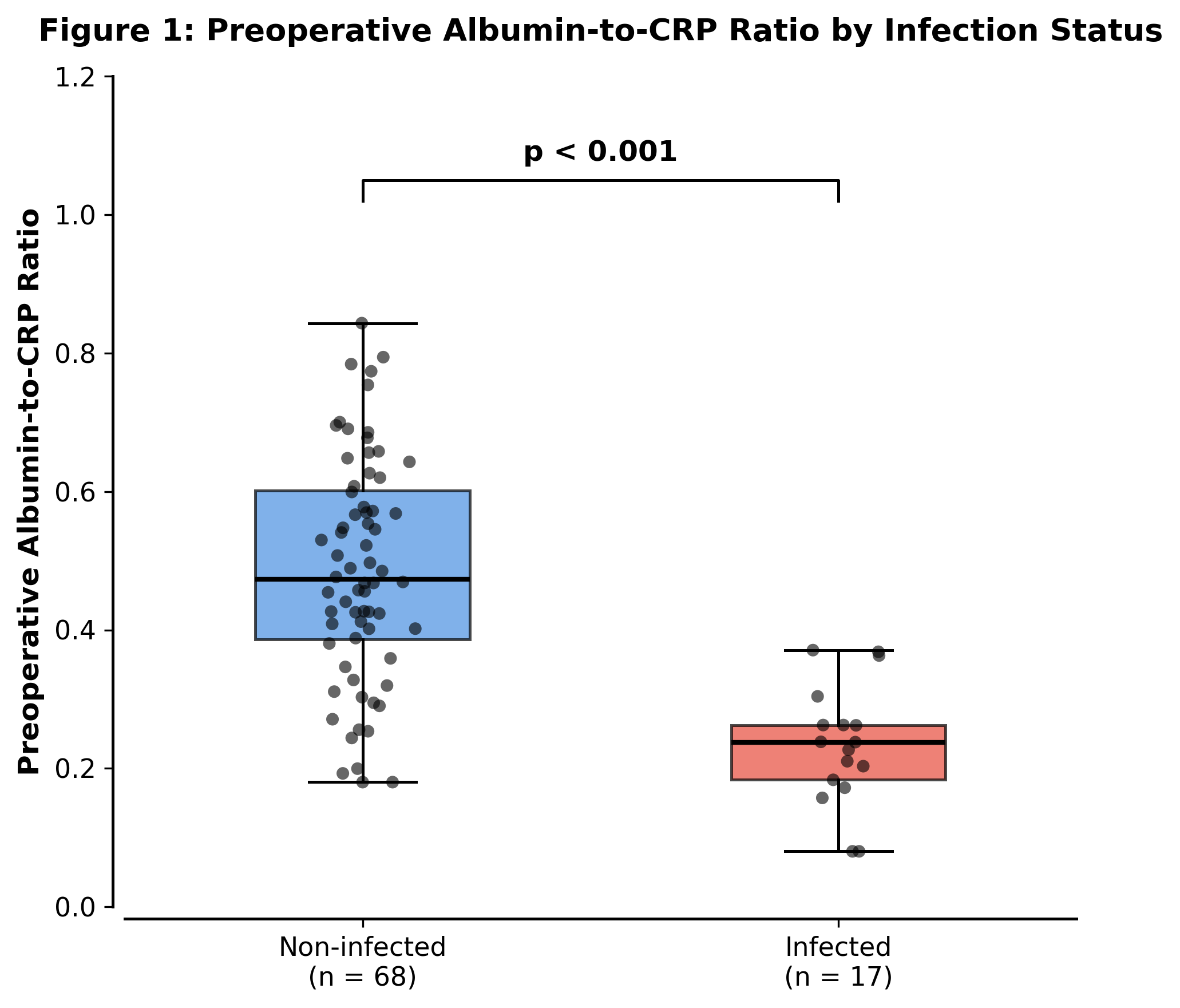
Results: Preoperative albumin-to-C-reactive protein ratio was significantly suppressed in infected patients compared with non-infected controls [median 0.22 (IQR 0.15–0.30) vs. 0.50 (IQR 0.36–0.68); p < 0.001]. Receiver operating characteristic analysis established superior discriminatory performance for Alb/CRP (AUC = 0.988; 95% CI: 0.82–0.98; cutoff ≤ 0.34; sensitivity 100.0%, specificity 95.6%). Multivariable logistic regression identified Alb/CRP ≤ 0.34 as an independent predictor of early acute infection (aOR = 9.10; 95% CI: 3.20–25.80; p < 0.001) alongside operative duration ≥ 120 minutes (aOR = 2.45; p = 0.028).

Conclusion: Preoperative albumin-to-C-reactive protein ratio serves as an outstanding, independent biomarker for early acute infection risk stratification following femur implant placement.

Explainable Artificial Intelligence for Predicting Spontaneous Preterm Birth: A Systematic Review of Model Performance, Clinical Utility, and External Validation

Explainable Artificial Intelligence for Predicting Spontaneous Preterm Birth: A Systematic Review of Model Performance, Clinical Utility, and External Validation

Volume 3, Issue 1, January and February 2027, Pages 100-112

https://doi.org/10.5281/zenodo.23161645

Azadeh Shiralizadeh, Nasrin Sanaei nasab

Abstract Spontaneous preterm birth (sPTB) remains the leading cause of neonatal morbidity and mortality worldwide, yet its accurate prediction continues to challenge obstetric care. Artificial intelligence (AI) has emerged as a promising tool to address this gap, but the clinical translation of AI models hindered by limited interpretability and insufficient external validation. This systematic review evaluated explainable AI (XAI) approaches for predicting sPTB, focusing on model performance, clinical utility, and external validation. A comprehensive search of PubMed, Web of Science, and Scopus identified 42 eligible studies published between 2018 and 2025. Studies assessed using the PROBAST risk-of-bias tool, and performance metrics extracted for narrative synthesis. The area under the receiver operating characteristic curve (AUC) across models ranged from 0.65 to 0.93, with XGBoost and ensemble methods demonstrating superior discrimination. Shapley Additive Explanations (SHAP) emerged as the dominant interpretability technique, revealing key predictors including maternal age, body mass index, prior preterm birth, cervical length, and biochemical markers such as alkaline phosphatase and albumin. External validation performed in only 38% of studies, with AUCs typically declining by 0.05–0.12 from internal validation. Clinical utility assessment via decision curve analysis reported in 29% of studies. Substantial heterogeneity in outcome definitions, predictor sets, and validation strategies limited meta-analytic pooling. This review highlights the need for standardized reporting of XAI methods, prospective external validation, and integration of clinical utility metrics before these models reliably deployed in obstetric practice.

Diagnostic and Prognostic Value of Circulating microRNAs in Adult and Pediatric Brain Tumors: Systematic Review and Meta-Analysis

Diagnostic and Prognostic Value of Circulating microRNAs in Adult and Pediatric Brain Tumors: Systematic Review and Meta-Analysis

Volume 2, Issue 3, Spring 2026, Pages 156-167

https://doi.org/10.22034/mphrj.2026.576338.1071

Ali Mohamadi Moghadam

Abstract Brain tumors remain among the most challenging malignancies in both adult and pediatric populations due to their heterogeneity, limited accessibility for biopsy, and variable clinical outcomes. Recently, circulating microRNAs (miRNAs) have emerged as promising minimally invasive biomarkers for cancer detection and prognosis. This systematic review and meta-analysis aimed to evaluate the diagnostic and prognostic value of circulating miRNAs in adult and pediatric brain tumors. A comprehensive literature search conducted across major electronic databases to identify eligible studies assessing circulating miRNAs in blood, serum, plasma, or cerebrospinal fluid of patients with primary brain tumors. Studies reporting diagnostic accuracy measures (sensitivity, specificity, area under the curve [AUC]) or survival outcomes (overall survival, progression-free survival, hazard ratios) were included. Data extracted and pooled using random-effects models. Study quality assessed using standardized appraisal tools. The meta-analysis demonstrated that circulating miRNAs exhibit significant diagnostic performance in differentiating brain tumor patients from healthy controls, with pooled sensitivity and specificity indicating moderate-to-high accuracy. Several miRNAs, including tumor-specific expression signatures, showed consistent upregulation or downregulation across gliomas, medulloblastomas, and other central nervous system tumors. Prognostically, elevated or reduced levels of specific circulating miRNAs were significantly associated with overall survival and disease progression, suggesting their potential role as independent prognostic indicators. Subgroup analyses revealed differences between adult and pediatric populations, reflecting underlying biological diversity. In conclusion, circulating miRNAs represent promising non-invasive biomarkers for the diagnosis and prognosis of brain tumors in both adults and children. However, heterogeneity in study design, sample processing, and analytical methods underscores the need for standardized protocols and large-scale prospective validation before clinical implementation.

Effectiveness of Nurse Led Triage Interventions on Patient Outcomes in Emergency Departments: A Systematic Review and Meta Analysis

Effectiveness of Nurse Led Triage Interventions on Patient Outcomes in Emergency Departments: A Systematic Review and Meta Analysis

Volume 2, Issue 3, Spring 2026, Pages 226-235

https://doi.org/10.22034/mphrj.2026.585044.1090

Fatemeh Karami

Abstract Background: Emergency department (ED) crowding compromises timely care and patient safety. Nurse led triage interventions, including physician led triage, triage liaison providers, and advanced triage protocols, have implemented to improve patient flow, but their overall effectiveness on patient outcomes remains uncertain.

Objective: To synthesise evidence on the effectiveness of nurse led triage interventions on critical patient outcomes in EDs.

Methods: We systematically searched PubMed, CINAHL, Embase, Cochrane Central, and Web of Science from inception to March 2026 for randomised controlled trials (RCTs) and high quality quasi experimental studies comparing nurse led triage interventions with conventional triage. Primary outcomes were ED length of stay (LOS), left without being seen (LWBS) rates, and mortality. Random effects meta analyses performed. Certainty of evidence assessed using GRADE.

Results: Twelve studies (N=12,847 patients) met inclusion criteria. Nurse led triage interventions significantly reduced ED LOS (SMD = –0.68; 95% CI: –0.85 to –0.51; p<0.001), decreased LWBS rates (OR = 0.51; 95% CI: 0.38 to 0.69; p<0.001), and lowered in ED mortality (OR = 0.61; 95% CI: 0.44 to 0.85; p=0.003). Heterogeneity was moderate to high (I²=58–72%).

Conclusion: Nurse led triage interventions are associated with clinically meaningful improvements in ED operational and safety outcomes. Implementation of advanced nurse led triage models prioritised to reduce crowding and improve patient outcomes.