Subjects = Breast Research
Number of Articles: 5
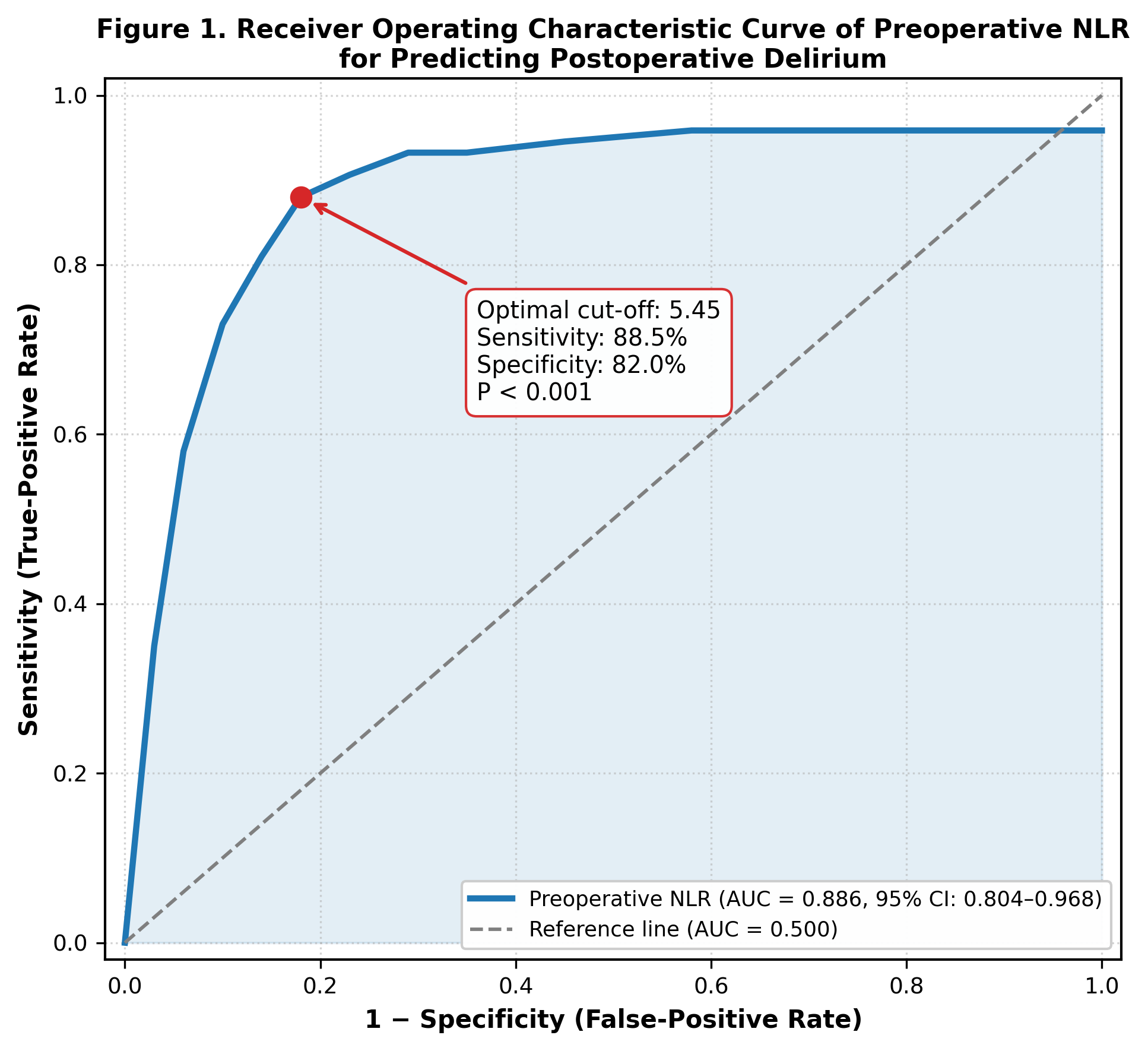
Pathophysiological Significance of the Neutrophil-to-Lymphocyte Ratio as a Predictor of Delirium After Major Emergency Orthopedic Surgery in the Elderly

Pathophysiological Significance of the Neutrophil-to-Lymphocyte Ratio as a Predictor of Delirium After Major Emergency Orthopedic Surgery in the Elderly

Volume 3, Issue 1, January and February 2027, Pages 67-75

https://doi.org/10.5281/zenodo.23161435

Tala Pourlak, Parham Maroufi

Abstract Introduction: Older adults undergoing major emergency orthopedic surgery face high risks of postoperative delirium (POD), a debilitating complication. Inflammation and stress, reflected by the neutrophil-to-lymphocyte ratio (NLR), may contribute to POD. This study evaluates NLR as a predictor of POD in this vulnerable cohort.

Material and methods: This study employed a descriptive cross-sectional design at Shohada Hospital, Tabriz, Iran, with 88 elderly patients undergoing major emergency orthopedic surgery. Convenience sampling and Cochran’s formula determined sample size. Inclusion criteria focused on age (≥65), surgery type, preoperative CBC availability, and post-op assessment capability, while excluding pre-existing cognitive impairment or confounding conditions. Data on demographics, clinical factors, and NLR were collected, with postoperative delirium as the primary outcome.

Results: A total of 88 patients were evaluated, with 26 (29.5%) developing postoperative delirium. Advanced age (P < 0.001), higher ASA status (P = 0.007), longer surgery (P = 0.018) and delay times (P = 0.005), lower albumin (P = 0.001), and elevated NLR (P < 0.001) were associated with delirium. Preoperative NLR (OR = 1.89, 95% CI: 1.29-2.77, P = 0.001) independently predicted delirium.

Conclusion: Preoperative NLR is a significant independent predictor of postoperative delirium in elderly patients undergoing major orthopedic surgery, suggesting its utility in risk stratification and early intervention strategies for this vulnerable population.

The Effect of Dexmedetomidine on Preventing Postoperative Delirium by Modulating Tumor Necrosis Factor-Alpha (TNF-α) Levels in Patients Undergoing Esophagectomy

The Effect of Dexmedetomidine on Preventing Postoperative Delirium by Modulating Tumor Necrosis Factor-Alpha (TNF-α) Levels in Patients Undergoing Esophagectomy

Volume 2, Issue 5, September and October 2026, Pages 391-399

https://doi.org/10.22034/mphrj.2026.587074.1103

Mansour Rezaei, Abbasali Dehghani

Abstract Introduction: Esophagectomy-induced systemic inflammation, specifically elevated TNF-α, significantly contributes to postoperative delirium. Dexmedetomidine may mitigate this cognitive decline through its potent anti-inflammatory and neuroprotective effects. This study investigates whether dexmedetomidine prevents postoperative delirium by modulating TNF-α levels in patients undergoing esophagectomy.

Material and methods: This prospective randomized study was conducted in 2023 at Imam Reza Hospital, Tabriz University of Medical Sciences. Fifty patients (25 per group), determined using the two independent sample formula, were enrolled. The primary variables included perioperative TNF α levels and the incidence of postoperative delirium, along with demographic characteristics, intraoperative hemodynamics, anesthetic requirements, and ICU stay duration.

Results: Dexmedetomidine significantly attenuated postoperative TNF α elevation compared with control, with a significant time by group interaction (P = 0.002) and lower TNF α levels at the end of surgery (P = 0.003) and 24 hours postoperatively (P < 0.001). The incidence of postoperative delirium was reduced (16.00% vs. 40.00%, P = 0.048), with delayed onset (P = 0.011), shorter duration (P = 0.004), and lower CAM ICU scores (P = 0.002). Peak TNF α levels correlated positively with delirium severity (r = 0.79, P < 0.001).

Conclusion: Perioperative dexmedetomidine administration reduced postoperative delirium and mitigated its severity following esophagectomy, likely through suppression of TNF α–mediated inflammatory responses. The observed association between inflammatory burden and delirium severity supports a mechanistic link between systemic inflammation and postoperative neurocognitive dysfunction.

Systematic Review of Bacterial Pathogens Associated with Prosthetic Joint Infection After Total Knee Arthroplasty

Systematic Review of Bacterial Pathogens Associated with Prosthetic Joint Infection After Total Knee Arthroplasty

Volume 2, Issue 5, September and October 2026, Pages 400-408

https://doi.org/10.22034/mphrj.2026.587090.1105

Alireza Aghili, Sina Najafi

Abstract Introduction: Prosthetic joint infection (PJI) remains one of the most serious complications following total knee arthroplasty, leading to substantial morbidity, repeated surgical procedures, and increased healthcare burden. These infections are primarily driven by bacterial colonization and biofilm formation on implant surfaces. Given the variability in reported causative microorganisms, the aim of this study was to systematically review the literature to identify the bacterial pathogens most commonly associated with PJI after total knee arthroplasty.

Material and methods: This systematic review followed PRISMA guidelines to identify bacterial pathogens associated with prosthetic joint infection after total knee arthroplasty. Studies were retrieved from PubMed, Web of Science, ScienceDirect, and Google Scholar using structured keywords. Two reviewers independently screened articles, and methodological quality of eligible observational studies was assessed using the Joanna Briggs Institute appraisal tools.

Results: Across four published case reports (n = 4), Ruminococcus/Mediterraneibacter gnavus was implicated in prosthetic joint infection (25%), deep surgical site infection (25%), bacteraemia (25%), and septic arthritis (25%), predominantly in elderly or immunocompromised patients. Identification relied on MALDI-TOF and/or 16S rRNA sequencing in all cases (100%), and favorable clinical outcomes were achieved with combined surgical management and targeted antibiotic therapy in the majority of reported infections.

Conclusion: Mediterraneibacter gnavus should be recognized as a rare but clinically significant opportunistic pathogen capable of causing orthopedic and systemic infections. Accurate diagnosis depends on advanced microbiological techniques, and outcomes appear favorable with timely surgical intervention and targeted antimicrobial therapy. Increased awareness may facilitate earlier detection and appropriate management.

Prevalence of Acute Postoperative Pain and Its Associated Risk Factors in Patients Undergoing Laparoscopic Hysterectomy

Prevalence of Acute Postoperative Pain and Its Associated Risk Factors in Patients Undergoing Laparoscopic Hysterectomy

Volume 2, Issue 4, July and August 2026, Pages 251-258

https://doi.org/10.22034/mphrj.2026.576415.1075

Mansour Rezaei, Naghi Abedini

Abstract Introduction: Acute postoperative pain remains a common concern following laparoscopic hysterectomy despite its minimally invasive nature. Pain severity is influenced by a complex interplay of patient characteristics, preexisting pain, psychological factors, surgical technique, and perioperative management. Identifying high‑risk patients is essential for optimizing analgesic strategies, enhancing recovery, and preventing long‑term pain‑related complications.

Material and methods: This observational study prospectively collected demographic and perioperative clinical data and followed patients through structured telephone interviews up to six months after surgery. Acute and chronic postoperative pain were assessed using validated numeric scales, alongside analgesic use and functional impact, allowing comprehensive evaluation of pain severity, distribution, and its influence on daily activities.

Results: In this cohort of women undergoing laparoscopic hysterectomy, postoperative pain declined progressively over time, with most patients achieving minimal pain by six months. Although chronic postsurgical pain affected a minority, pelvic and incisional pain predominated. Analgesic requirements varied, while functional impairment was generally limited, highlighting favorable pain recovery trajectories overall.

Conclusion: these findings reinforce the effectiveness of laparoscopic hysterectomy as a minimally invasive procedure with generally favorable pain and functional outcomes, while also highlighting the complexity of pain recovery in a minority of patients.

Clinical Outcomes of Postmenopausal Obese Women Admitted to the Intensive Care Unit After Thoracic Surgery

Clinical Outcomes of Postmenopausal Obese Women Admitted to the Intensive Care Unit After Thoracic Surgery

Volume 2, Issue 2, Winter 2026, Pages 88-95

https://doi.org/10.22034/mphrj.2026.576402.1073

Mansour Rezaei, Hossein Shiri

Abstract Introduction: Obese postmenopausal women undergoing thoracic surgery represent a high‑risk population due to the combined effects of hormonal deprivation, metabolic dysfunction, and reduced cardiopulmonary reserve. These factors significantly increase postoperative complications, ICU admission rates, and mortality, underscoring the need for tailored perioperative and critical care strategies in this vulnerable group.

Material and methods: This retrospective cross sectional study reviewed medical records of postmenopausal women admitted to the intensive care units of Imam Reza Hospital over a five year period. Clinical, demographic, and outcome data were collected using predefined criteria, and statistical analyses were performed with SPSS to evaluate associations between obesity, ICU outcomes, and mortality.

Results: Obese postmenopausal women admitted to the ICU after thoracic surgery exhibited significantly worse clinical outcomes compared with non obese patients. Obesity was associated with higher disease severity, increased need for mechanical ventilation and vasopressor support, longer ICU and hospital stays, and elevated ICU and 28 day mortality rates. These findings highlight obesity as a major determinant of postoperative morbidity and short term mortality in critically ill postmenopausal women.

Conclusion: In conclusion, our study demonstrates that obesity markedly deteriorates short term clinical outcomes among postmenopausal women admitted to the ICU following thoracic surgery. The data reveal higher disease severity, prolonged intensive care utilization, increased organ failure, and substantially greater mortality rates compared with non obese patients.