Subjects = Education
Number of Articles: 3
Effects of Surgical Anatomy Study Guide–Based Education on the Clinical Performance of Operating Room Students: Catheterization, Patient Transfer, Wound Closure, Instrument Handling, Positioning, and Hemostasis

Effects of Surgical Anatomy Study Guide–Based Education on the Clinical Performance of Operating Room Students: Catheterization, Patient Transfer, Wound Closure, Instrument Handling, Positioning, and Hemostasis

Volume 2, Issue 6, November and December 2026, Pages 472-482

https://doi.org/10.5281/zenodo.22030706

Mahmood Kohan, Sevda hazrati

Abstract Introduction: Surgical anatomy underpins every core perioperative skill, yet operating room students often struggle to translate anatomical theory into clinical practice. Targeted study guides that integrate anatomy with procedural workflow may bridge this gap. This study aimed to determine the effects of surgical anatomy study guide–based education on the clinical performance of operating room students across catheterization, patient transfer, wound closure, instrument handling, positioning, and hemostasis.

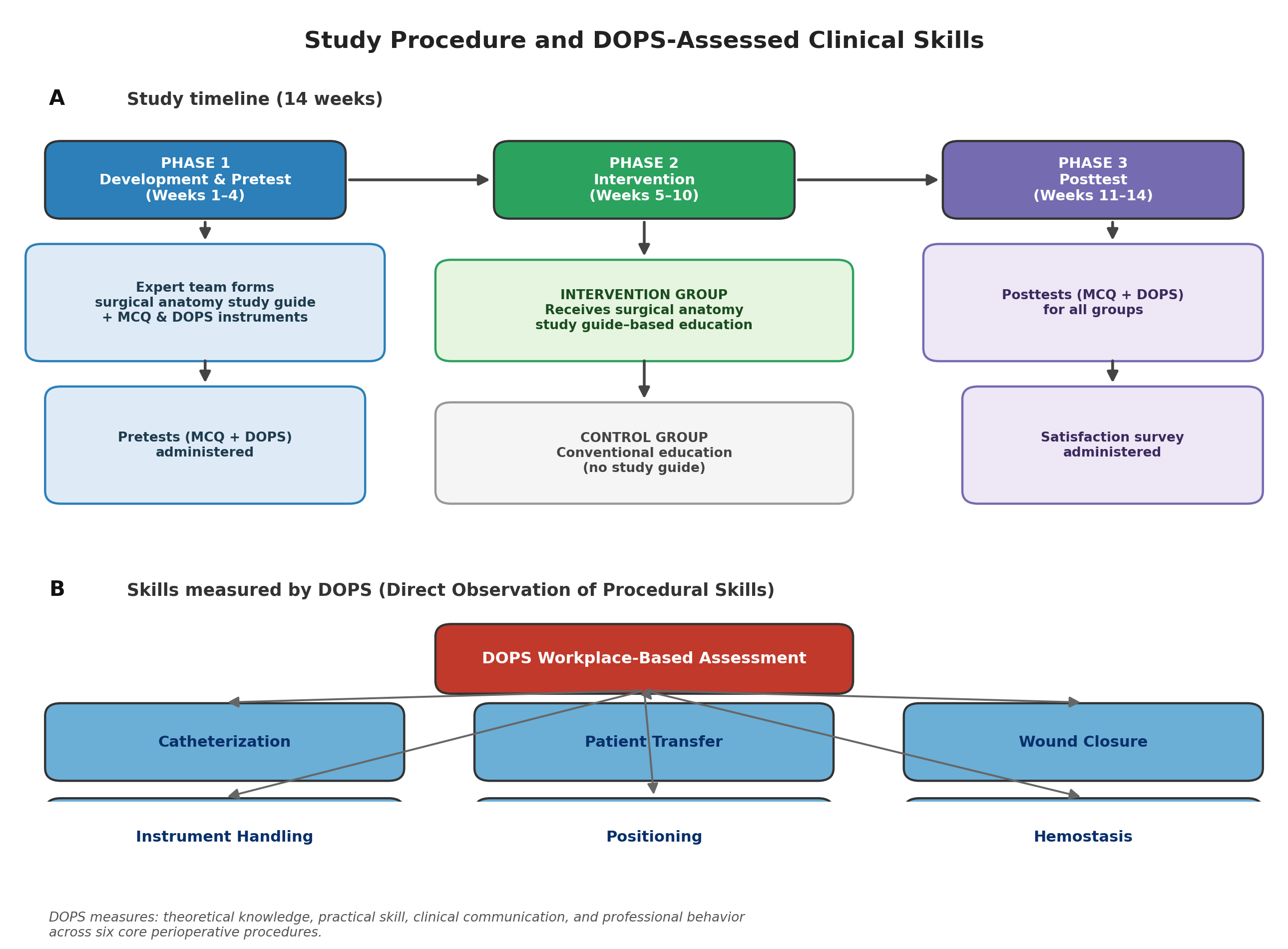
Material and methods: This quasi-experimental study with a Solomon four-group design included 60 undergraduate operating room students. Over fourteen weeks, the intervention groups received surgical anatomy study guide–based education while controls received conventional teaching. Six procedural skills were assessed before and after using Direct Observation of Procedural Skills (DOPS) and multiple-choice examinations.

Results: Direct observation and feedback times varied across skills, with wound closure requiring the longest observation (14.30 min) and patient transfer the shortest (5.02 min). DOPS scores increased across groups: control (280.91±49.72), control+pretest (319.09±39.30), intervention (359.33±84.13), and intervention+pretest (404.47±70.42). The intervention group scored significantly higher than controls (t = -3.62, df = 24, p < 0.001; mean difference = 85.38).

Conclusion: In conclusion, this study provides evidence that surgical anatomy study guide–based education significantly enhances the clinical performance of operating room technology students across six core perioperative skills, with the greatest benefits observed when the intervention is combined with pretesting.
Designing a Surgical Anatomy Education Program for Surgical Technology Students

Designing a Surgical Anatomy Education Program for Surgical Technology Students

Volume 2, Issue 6, November and December 2026, Pages 483-491

https://doi.org/10.5281/zenodo.22031025

Mahmood Kohan, Sevda hazrati

Abstract Introduction: Surgical technology students need anatomy teaching that is directly linked to operative practice, as traditional lecture-based methods often fail to prepare them for the demands of the operating room. A structured, learner-centered program may improve understanding, confidence, and clinical readiness. This study aimed to design a surgical anatomy education program for surgical technology students.

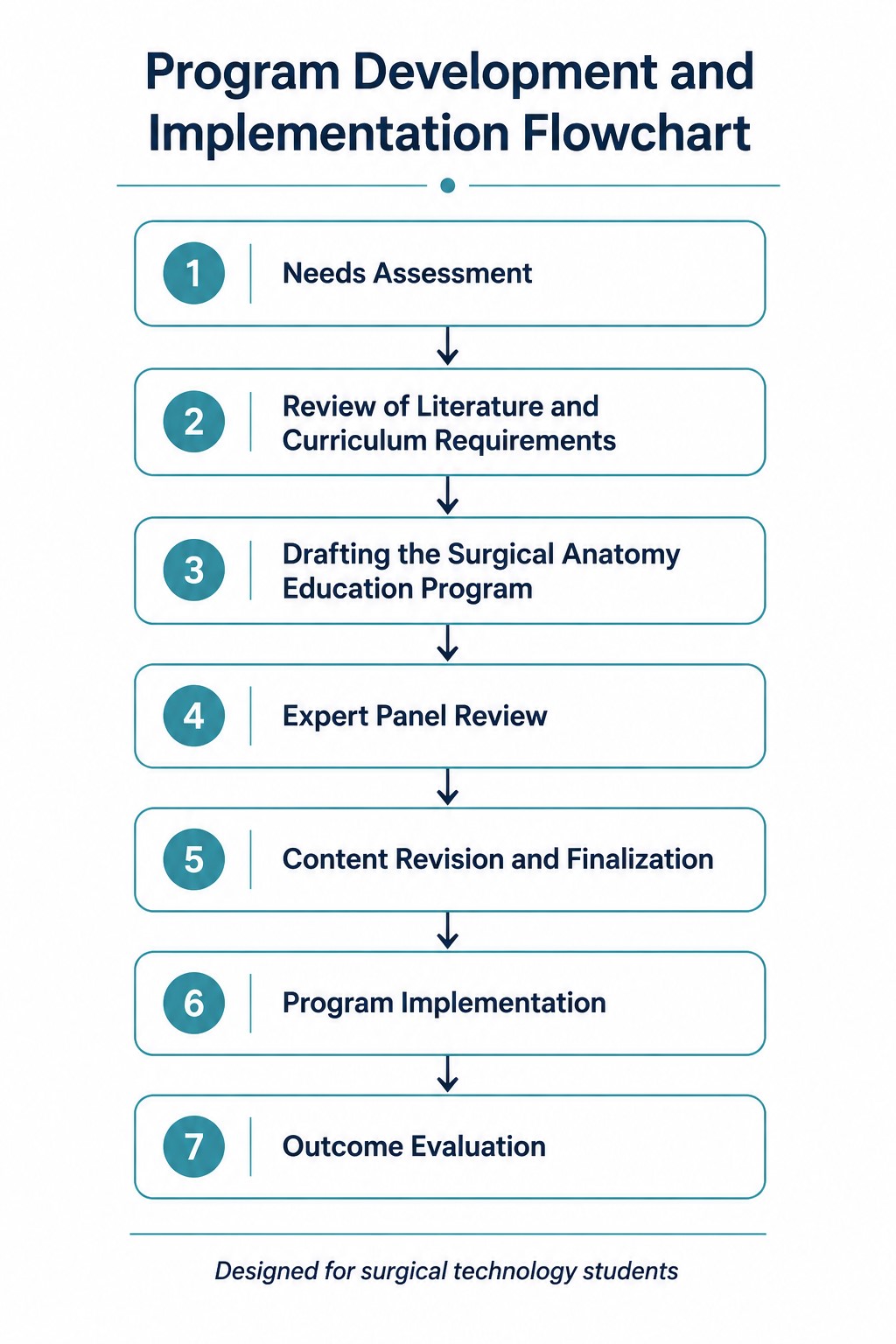
Material and methods: This educational study designed and validated a surgical anatomy program for surgical technology students through needs assessment, expert review, and structured content development. The program was then implemented using a planned instructional approach that linked anatomy to operating room practice. Outcomes were evaluated with appropriate instruments, and the study followed standard ethical principles, including informed consent, confidentiality, and ethics approval.

Results: The surgical anatomy education program showed strong expert endorsement and clear structural coherence, with high validity across most domains (overall CVI=0.97; mean content relevance = 4.70±0.41; mean clarity=4.69±0.44; mean necessity=4.75±0.41). The highest ratings were observed for program structure, core topics, procedural guidance, and layout (CVR=1.00; CVI=1.00), while self-assessment questions required the most revision (CVR=0.60; CVI=0.90). The development process was systematic and iterative, progressing from needs assessment to expert review, revision, implementation, and evaluation.

Conclusion: This study indicates that a carefully designed, expert-validated surgical anatomy program can provide a credible foundation for surgical technology education. Its strong content validity and clinically aligned structure suggest that it is suitable for implementation and may improve the relevance and quality of anatomy teaching in the operating room context.

The Role of Artificial Intelligence in Computer Science Education Focus on Database Instruction, A Systematic Review

The Role of Artificial Intelligence in Computer Science Education Focus on Database Instruction, A Systematic Review

Volume 2, Issue 2, Winter 2026, Pages 125-136

https://doi.org/10.22034/mphrj.2026.576863.1078

Amirhossein Ghodsinasab

Abstract The rapid evolution of Artificial Intelligence (AI) has significantly affected various domains of education, particularly Computer Science Education (CSE). This systematic review critically examines the role of AI-driven technologies in enhancing learning and teaching processes within CSE, with a specific focus on database instruction. By synthesizing empirical studies, educational interventions, and theoretical frameworks published between 2010 and 2025, the review identifies key AI applications, pedagogical benefits, challenges, and future research directions. The integration of AI in CSE is shown to support personalized learning, intelligent tutoring, automated assessment, and adaptive feedback—each contributing to improved student engagement and performance. In the specific context of database education, AI technologies such as intelligent tutoring systems, natural language interfaces, and machine learning-based recommendation engines assist students in grasping complex concepts like relational schema design, query optimization, and transaction management. Furthermore, AI-driven analytics enable instructors to identify learning gaps, monitor progress, and adjust instructional strategies in real time. Despite promising outcomes, challenges persist, including the scarcity of domain-specific intelligent tools, data privacy concerns, technical infrastructure limitations, and the need for instructor training. Ethical considerations around algorithmic bias and transparency in AI-supported learning environments also highlighted. The review finds a growing trend toward hybrid pedagogical models that combine AI support with human-led instruction, suggesting enhanced learning efficacy when AI tools integrated thoughtfully into curricula. Finally, this review proposes a set of research recommendations such as developing explainable AI systems tailored to database education, longitudinal studies to measure learning impacts, and frameworks for scalable implementation. Addressing these avenues can facilitate more effective and equitable AI-enhanced education in computer science.