
Subjects = Clinical Science Research
Number of Articles: 10
Multimodal Artificial Intelligence for Early Prediction of Preeclampsia Using Maternal Clinical, Biochemical, and Ultrasound Data: A Systematic Review

Multimodal Artificial Intelligence for Early Prediction of Preeclampsia Using Maternal Clinical, Biochemical, and Ultrasound Data: A Systematic Review

Volume 3, Issue 1, January and February 2027, Pages 49-66

https://doi.org/10.5281/zenodo.23161843

Azadeh Shiralizadeh, Nasrin Sanaei nasab

Abstract Background: Preeclampsia remains a leading cause of maternal and perinatal morbidity and mortality worldwide, affecting 2–8% of pregnancies globally. Early prediction is critical for implementing prophylactic interventions, yet traditional risk models demonstrate limited predictive accuracy. Multimodal artificial intelligence (AI) approaches integrating clinical, biochemical, and ultrasound data offer a promising avenue for improving early detection. Objective: This systematic review synthesizes evidence on multimodal AI models for early prediction of preeclampsia, evaluating model architectures, data integration strategies, predictive performance, and barriers to clinical translation. Methods: Following PRISMA 2020 guidelines, a comprehensive search of PubMed, Scopus, Embase, IEEE Xplore, and Web of Science conducted through July 2025. Studies were eligible if they developed or validated AI models integrating at least two data modalities (clinical, biochemical, ultrasound, or other imaging) for preeclampsia prediction. Risk of bias assessed using PROBAST. Results: From 2,457 identified records, 18 studies met inclusion criteria. Multimodal AI models demonstrated area under the curve (AUC) values ranging from 0.78 to 0.98, consistently outperforming unimodal approaches and traditional logistic regression. The highest-performing models integrated maternal characteristics, mean arterial pressure, placental growth factor (PlGF), and uterine artery Doppler indices. Deep learning architectures, particularly convolutional neural networks for ultrasound analysis and ensemble methods for structured clinical data, showed superior performance. However, only 22.2% of studies performed external validation, and substantial heterogeneity in predictor definitions, outcome ascertainment, and validation strategies limited comparability. SHAP analysis revealed that PlGF, mean uterine artery pulsatility index, and maternal history contributed most strongly to predictions. Conclusions: Multimodal AI demonstrates significant potential for early preeclampsia prediction, with performance exceeding traditional screening. However, limited external validation, inconsistent reporting, and underutilization of ultrasound data constrain clinical translation. Prospective multicenter validation and standardized reporting frameworks are essential before routine implementation.

Effectiveness of Antibiotic Prophylaxis in Preventing Postoperative Infection Following Total Knee Arthroplasty: A Systematic Review

Effectiveness of Antibiotic Prophylaxis in Preventing Postoperative Infection Following Total Knee Arthroplasty: A Systematic Review

Volume 2, Issue 6, November and December 2026, Pages 429-437

https://doi.org/10.22034/mphrj.2026.587088.1104

Alireza Aghili, Sina Najafi

Abstract Introduction: Total knee arthroplasty is an effective treatment for advanced knee disorders but remains vulnerable to postoperative infections, including periprosthetic joint infection, which can lead to serious complications and increased healthcare burden. Antibiotic prophylaxis is widely used to reduce this risk, yet optimal strategies remain debated. Therefore, this study aims to systematically review the evidence regarding the effectiveness of antibiotic prophylaxis in preventing infection following TKA.

Material and methods: This systematic review was conducted according to PRISMA guidelines. Eligible studies included randomized and observational research evaluating antibiotic prophylaxis in adult patients undergoing total knee arthroplasty with reported postoperative infection outcomes. Multiple databases were searched using MeSH terms and related keywords by two independent reviewers. Study quality was assessed using the Newcastle–Ottawa Scale and the Cochrane Risk of Bias tool.

Results: The literature search identified 851 records, of which nine studies met the inclusion criteria after screening and full text assessment. Overall, intravenous antibiotic regimens demonstrated moderate to high treatment success across studies, with reported success rates ranging from 63% to 90% and follow up durations varying between 3.5 and 72 months. Most regimens involved glycopeptide or rifampicin based therapies administered for approximately 2–6 weeks, with generally favorable clinical outcomes.

Conclusion: The available evidence suggests that intravenous antibiotic therapy provides generally favorable outcomes in the management of infection related complications. Across the included studies, treatment success was consistently moderate to high despite variations in antimicrobial regimens, treatment duration, and follow up periods. Glycopeptide and rifampicin based therapies appear to play a central role in achieving effective infection control.

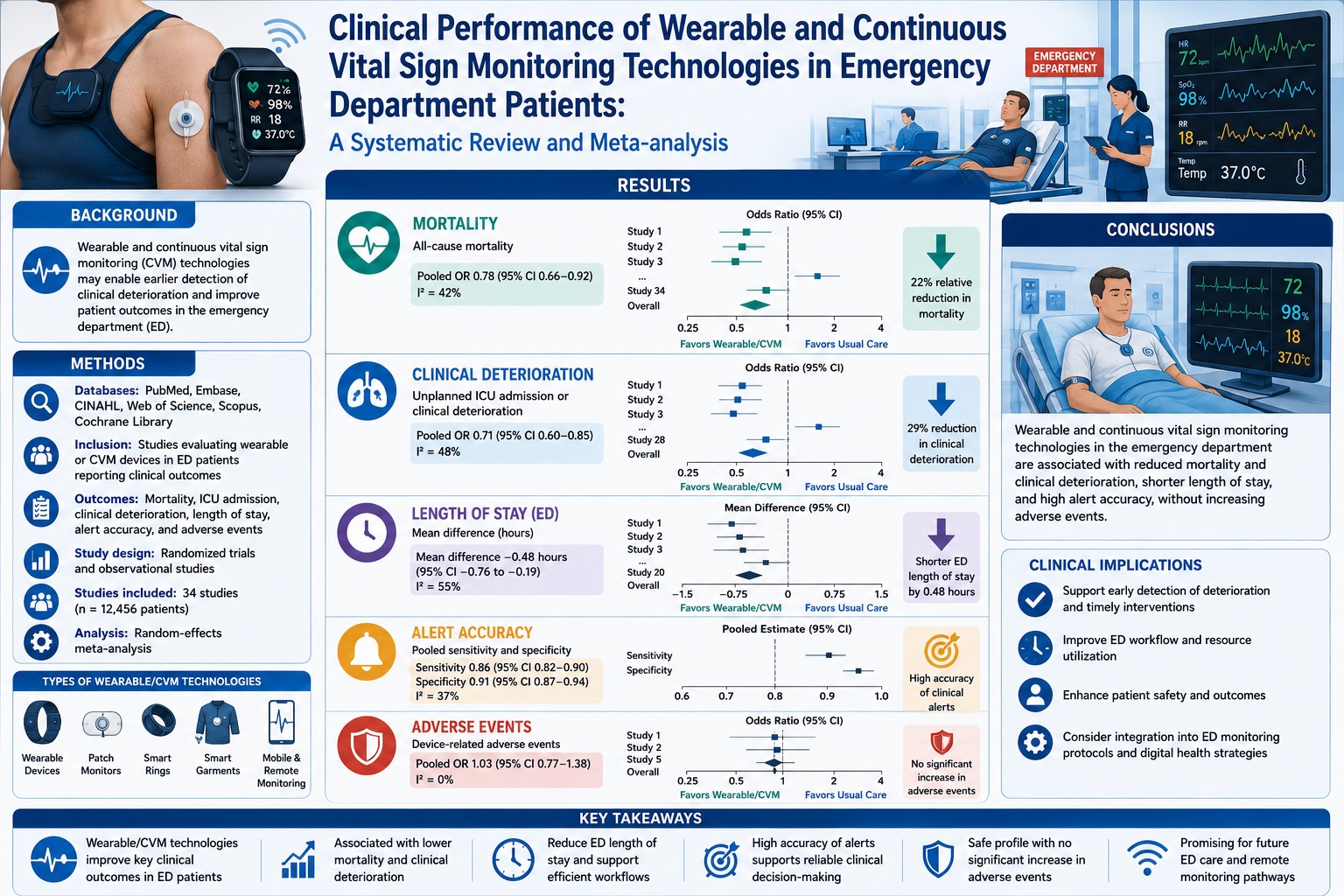
Clinical Performance of Wearable and Continuous Vital Sign Monitoring Technologies in Emergency Department Patients: A Systematic Review and Meta-analysis

Clinical Performance of Wearable and Continuous Vital Sign Monitoring Technologies in Emergency Department Patients: A Systematic Review and Meta-analysis

Volume 2, Issue 6, November and December 2026, Pages 461-471

https://doi.org/10.5281/zenodo.21955209

Roxana Hessam, Maryam Milanifard

Abstract Emergency departments (EDs) characterized by rapid patient turnover, unpredictable clinical deterioration, and the need for timely recognition of physiological instability. Conventional intermittent vital sign assessment may fail to detect transient or progressive changes in critically ill patients, creating opportunities for wearable and continuous monitoring technologies. This systematic review and meta-analysis aimed to evaluate the clinical performance, accuracy, reliability, and practical implications of wearable and continuous vital sign monitoring systems in emergency department populations. A comprehensive literature search conducted across major biomedical databases to identify studies evaluating wearable devices, wireless sensors, continuous electrocardiography (ECG), pulse oximetry, respiratory monitoring, non-invasive blood pressure monitoring, and multimodal physiological monitoring systems in ED patients. Studies reporting diagnostic accuracy, agreement with reference measurements, detection of clinical deterioration, workflow impact, or patient outcomes were included. Data extraction focused on technology characteristics, patient populations, monitoring parameters, performance outcomes, and methodological quality. The pooled findings demonstrated that wearable and continuous monitoring technologies generally provided acceptable agreement with conventional bedside measurements, particularly for heart rate, oxygen saturation, and respiratory rate monitoring. Continuous systems showed improved detection of physiological abnormalities compared with intermittent monitoring, although performance variability observed across devices and clinical settings. Meta-analysis indicated significant improvements in early recognition of deterioration events and enhanced monitoring continuity, while limitations remained regarding motion artifacts, calibration requirements, data integration, and clinical alarm management. Wearable monitoring technologies appear to represent a valuable adjunct to conventional ED assessment by enabling earlier identification of patient instability and supporting personalized clinical decision-making. However, further large-scale prospective studies are required to determine their impact on mortality, resource utilization, and cost-effectiveness.

Serum Creatinine Dynamics During the First 48 Hours After Major Surgery Following Intraoperative Diuretic Administration

Serum Creatinine Dynamics During the First 48 Hours After Major Surgery Following Intraoperative Diuretic Administration

Volume 2, Issue 4, July and August 2026, Pages 285-294

https://doi.org/10.22034/mphrj.2026.586271.1096

Naghi Abedini, Yashar Eslampoor

Abstract Introduction: Serum creatinine continues to serve as a key marker for evaluating renal function in the perioperative setting. The early postoperative period, particularly the first 48 hours after major surgery, is a critical timeframe during which subtle biochemical changes may signal evolving kidney stress or injury.

Material and methods: This prospective observational study was conducted in 2025 at Shohada Hospital, Tabriz, to evaluate serum creatinine changes during the first 48 postoperative hours following intraoperative furosemide administration in major surgery patients. Fifty participants were enrolled through convenience sampling. Serum creatinine was measured preoperatively and every six hours postoperatively.

Results: Serum creatinine increased significantly during the first 48 postoperative hours following intraoperative diuretic administration, rising from a baseline median of 0.96 mg/dL (IQR: 0.84–1.10) to a peak of 1.15 mg/dL (IQR: 1.00–1.35) at approximately 30 hours (P < 0.001). Patients aged ≥45 years demonstrated greater postoperative elevations than younger individuals (P=0.018), while female patients showed slightly higher mid postoperative creatinine levels compared with males (P=0.041). Despite these differences, creatinine values gradually declined toward baseline by 48 hours.

Conclusion: Intraoperative diuretic administration was associated with temporary postoperative changes in serum creatinine that remained clinically modest and largely reversible. Advanced age and female sex appeared to influence the magnitude of renal biochemical responses. Careful perioperative renal monitoring, particularly in older patients, may help optimize postoperative management and facilitate early identification of transient renal function changes.

Comparison of Hemodynamic Responses to 50 Microgram Fentanyl Administration Across Different Age Groups During General Anesthesia

Comparison of Hemodynamic Responses to 50 Microgram Fentanyl Administration Across Different Age Groups During General Anesthesia

Volume 2, Issue 4, July and August 2026, Pages 295-305

https://doi.org/10.22034/mphrj.2026.586277.1098

Yashar Eslampoor, Naghi Abedini

Abstract Introduction: Given the importance of maintaining cardiovascular stability during anesthesia and the potential influence of age on opioid responsiveness, further investigation into the hemodynamic effects of fentanyl across different age groups is warranted. The present study was designed to compare the hemodynamic responses associated with administration of 50 micrograms of fentanyl during general anesthesia among patients of different age categories.

Material and methods: This prospective study was conducted in 2025 at Shohada Hospital to evaluate age related hemodynamic responses to fentanyl during general anesthesia. A total of 100 patients were enrolled using convenience sampling and categorized into four age groups. All participants received 50 µg intravenous fentanyl during anesthetic induction. Hemodynamic parameters, including heart rate and blood pressure, were recorded every five minutes for one hour.

Results: Younger patients (18–30 years) exhibited higher baseline hemodynamic values and greater early fluctuations, whereas patients older than 50 years showed lower baseline values and more sustained declines. Significant time–age interactions were observed for heart rate (P = 0.021), systolic blood pressure (P = 0.014), and diastolic blood pressure (P = 0.018). Supplemental opioid requirements showed only modest intergroup variation.

Conclusion: Age significantly influences cardiovascular responses to fentanyl during general anesthesia. Older patients demonstrated greater hemodynamic vulnerability and less physiologic stability, while younger individuals exhibited more dynamic but transient cardiovascular changes. Despite these differences, supplemental opioid requirements remained relatively comparable among age groups, emphasizing the importance of individualized intraoperative monitoring and anesthetic management rather than opioid dosing based solely on chronological age.

Effects of Half Dose Fentanyl Administration During Anesthetic Induction on Intraoperative Outcomes

Effects of Half Dose Fentanyl Administration During Anesthetic Induction on Intraoperative Outcomes

Volume 2, Issue 4, July and August 2026, Pages 306-316

https://doi.org/10.22034/mphrj.2026.586272.1097

Naghi Abedini, Yashar Eslampoor

Abstract Introduction: Given the ongoing interest in opioid sparing anesthesia and the importance of maintaining hemodynamic stability during surgery, investigation of reduced fentanyl dosing during anesthetic induction is clinically justified. Understanding the intraoperative consequences of administering half the conventional fentanyl dose may help clarify whether lower opioid exposure can effectively balance sympathetic suppression, cardiovascular stability, anesthetic adequacy, and postoperative recovery.

Material and methods: This prospective observational study was conducted at Shohada Hospital in 2025 on 50 patients undergoing surgery under general anesthesia to evaluate postoperative serum creatinine changes following intraoperative furosemide administration. Serum creatinine levels were measured every 6 hours during the first 48 postoperative hours using standardized laboratory methods.

Results: Heart rate and blood pressure parameters demonstrated significant temporal fluctuations during the first hour after anesthetic induction, with all hemodynamic changes reaching statistical significance (P<0.001). Heart rate showed an early transient increase followed by stabilization, while systolic and diastolic blood pressures initially decreased and gradually recovered over time. In addition, supplemental opioid requirement increased progressively during the first 6 intraoperative hours, with a significant overall variation in analgesic demand (P=0.032), indicating dynamic perioperative nociceptive responses.

Conclusion: Anesthetic induction was associated with transient but clinically controlled hemodynamic alterations during the early intraoperative period. Despite significant fluctuations in heart rate and blood pressure, overall cardiovascular stability was maintained throughout monitoring. Furthermore, the progressive increase in opioid requirement highlights the evolving nature of intraoperative nociceptive stimulation and emphasizes the importance of continuous analgesic titration during surgical procedures.

Hemodynamic Effects and Complications of Bone Cement Utilization in Orthopedic Operations

Hemodynamic Effects and Complications of Bone Cement Utilization in Orthopedic Operations

Volume 2, Issue 4, July and August 2026, Pages 317-328

https://doi.org/10.22034/mphrj.2026.586278.1099

Yashar Eslampoor, Naghi Abedini

Abstract Introduction: In contemporary orthopedic practice, bone cement continues to play a vital role in achieving successful surgical outcomes and improving patient mobility and quality of life. Nevertheless, its utilization is accompanied by important physiological effects that demand careful consideration. Hemodynamic changes associated with bone cement application represent a significant perioperative challenge due to their unpredictable nature and potential severity.

Material and methods: This prospective observational study was conducted at Shohada Hospital in 2025 to evaluate hemodynamic changes and complications associated with bone cement use during orthopedic surgery. A total of 200 patients were enrolled through convenience sampling. Perioperative cardiovascular and respiratory parameters were continuously monitored and recorded at predefined intervals.

Results: Among 200 patients undergoing cemented orthopedic surgery, hypotension was the most common intraoperative complication (29.00%), followed by tachycardia (20.50%) and hypertension (17.00%). Suspected Bone Cement Implantation Syndrome (BCIS) occurred in 11.00% of cases, while severe Grade 3 BCIS was identified in 1.00% of patients. Hemodynamic complications were significantly associated with older age, higher ASA class, cardiovascular comorbidities, prolonged surgery duration, and the use of general anesthesia.

Conclusion: Bone cement utilization in orthopedic procedures is associated with clinically important hemodynamic alterations and varying degrees of BCIS. Although most complications were transient and manageable, elderly patients and those with significant comorbidities demonstrated a higher risk of perioperative instability.

Dental Implants vs. Traditional Bridges: A Comparative Clinical Review

Dental Implants vs. Traditional Bridges: A Comparative Clinical Review

Volume 2, Issue 3, Spring 2026, Pages 189-198

https://doi.org/10.22034/mphrj.2026.585033.1086

Martin Zbuzant

Abstract Tooth loss long been treated through various restorative techniques, with dental implants and traditional fixed bridges representing two dominant modalities. This comparative clinical review aims to evaluate the long-term functional, aesthetic, biomechanical, and economic outcomes associated with dental implants versus conventional bridgework. A systematic analysis of randomized clinical trials, longitudinal cohort studies, and meta-analyses published between 2010 and 2025 conducted. Parameters assessed include survival rates, marginal bone loss, patient satisfaction, maintenance requirements, and cost-effectiveness. Findings reveal that implant-supported restorations demonstrate a superior survival rate (94-98% over 10 years) compared to traditional bridges (85-92%), primarily due to the preservation of alveolar bone and independence from adjacent teeth. Moreover, implants offer improved masticatory performance and aesthetic stability but require surgical intervention, appropriate bone quality, and higher initial cost. Traditional bridges, in contrast, provide faster treatment and lower upfront cost but are associated with increased abutment-tooth complications and secondary caries. From an evidence-based perspective, implants demonstrate greater long-term clinical and patient-reported success, though economic accessibility remains a limiting factor in some healthcare contexts. The review concludes that an individualized approach considering patient systemic health, bone availability, and financial capacity remains essential in prosthodontic decision-making.

A Systematic Review and Meta Analysis: Impact of Emergency Department Nursing Interventions on Patient Safety and Clinical Outcomes:

A Systematic Review and Meta Analysis: Impact of Emergency Department Nursing Interventions on Patient Safety and Clinical Outcomes:

Volume 2, Issue 3, Spring 2026, Pages 199-211

https://doi.org/10.22034/mphrj.2026.585042.1089

Fatemeh Karami

Abstract Background: Emergency departments (EDs) represent high-acuity, high-volume environments where nursing interventions critically influence patient safety and clinical outcomes. Despite the central role of emergency nurses, the aggregate evidence supporting specific nursing interventions remains fragmented.

Objective: This systematic review and meta-analysis evaluates the effectiveness of ED nursing interventions on patient safety indicators and clinical outcomes, including infection rates, medication administration safety, pain management efficiency, waiting times, and hospital readmission rates.

Methods: Following PRISMA guidelines, we systematically searched PubMed, Cochrane Library, Scopus, Web of Science, and CINAHL from inception to May 2026. Randomized controlled trials, quasi-experimental studies, and observational studies evaluating nurse-led interventions in ED settings were included. A random-effects meta-analysis conducted using Stata 16.0. Heterogeneity was assessed using I² statistics, and publication bias evaluated via funnel plots and Egger's test.

Results: Twenty-nine studies (N=12,847 patients) met inclusion criteria. Nursing interventions significantly reduced healthcare-associated infections (OR=0.69, 95% CI: 0.65-0.74, p<0.001), medication administration errors (RR=0.58, 95% CI: 0.47-0.71, p<0.001), and time-to-analgesia administration (SMD=-1.24, 95% CI: -1.67 to -0.81, p<0.001). Emergency department length of stay was reduced by approximately 25 minutes (95% CI: -32.4 to -17.6, p<0.001). Hand hygiene protocols demonstrated the greatest infection reduction efficacy (OR=0.62, 95% CI: 0.57-0.68).

Conclusions: Emergency department nursing interventions substantially improve patient safety and clinical outcomes across multiple domains. Standardizing evidence-based nursing protocols, particularly for infection control and medication administration represents a high-yield strategy for enhancing emergency care quality.

AI-Assisted Diagnosis and Management of Renal Colic: Opportunities, Challenges, and Future Directions

AI-Assisted Diagnosis and Management of Renal Colic: Opportunities, Challenges, and Future Directions

Volume 1, Issue 11, November 2025, Pages 359-369

https://doi.org/10.22034/mphrj.2025.559987.1050

Zahra Sadeghi

Abstract Renal colic, a severe and common urological emergency, poses persistent diagnostic and management challenges despite advances in imaging and therapeutic modalities. Conventional approaches, including non-contrast computed tomography and ultrasonography, are limited by radiation exposure, operator dependency, and diagnostic variability. In recent years, artificial intelligence (AI) encompassing machine learning (ML), deep learning (DL), and data-driven predictive analytics has emerged as a transformative tool in medical diagnostics and clinical decision-making. This review synthesizes current evidence on the application of AI in the diagnosis and management of renal colic, highlighting its opportunities, limitations, and future potential.

AI-assisted imaging models have demonstrated diagnostic accuracy comparable to expert radiologists in detecting and characterizing urinary stones, while also enabling low-dose imaging and automated obstruction grading. Predictive algorithms integrating clinical, biochemical, and imaging data can estimate the likelihood of spontaneous stone passage, recurrence, and treatment response, supporting personalized and cost-effective care. Furthermore, AI-driven systems are increasingly integrated into emergency department workflows and telemedicine platforms to optimize triage and reduce diagnostic delays.

Despite these promising developments, significant challenges remain regarding data quality, model generalizability, ethical governance, and clinical validation. Future directions include the integration of multi-omics data, federated learning for privacy-preserving collaboration, and explainable AI for transparent clinical interpretation. Ultimately, AI holds the potential to redefine renal colic management through enhanced accuracy, efficiency, and individualized care marking a critical step toward precision urology.