Keywords = Patient Safety
Number of Articles: 3
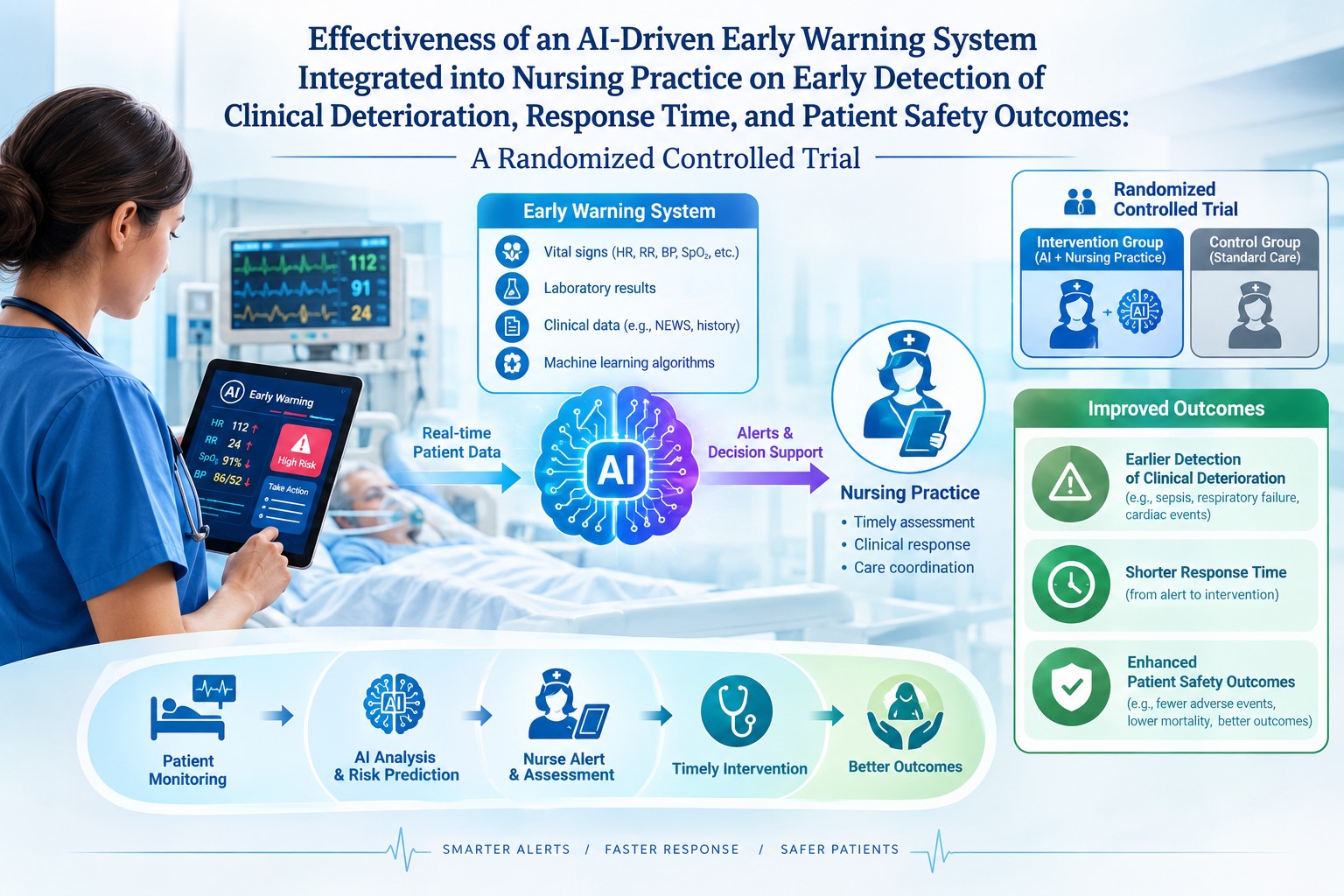
Effectiveness of an AI-Driven Early Warning System Integrated into Nursing Practice on Early Detection of Clinical Deterioration, Response Time, and Patient Safety Outcomes: A Randomized Controlled Trial

Effectiveness of an AI-Driven Early Warning System Integrated into Nursing Practice on Early Detection of Clinical Deterioration, Response Time, and Patient Safety Outcomes: A Randomized Controlled Trial

Volume 3, Issue 1, January and February 2027, Pages 76-91

https://doi.org/10.5281/zenodo.23161499

Elham Mohammadzadeh

Abstract Background: Clinical deterioration in hospitalized patients often precedes adverse events such as cardiac arrest, unplanned intensive care unit (ICU) admission, and mortality. While traditional early warning systems (EWS) based on vital signs have improved detection, their predictive accuracy and integration into nursing workflow remain suboptimal. Artificial intelligence (AI)-driven systems leveraging nursing surveillance data may enhance early detection and response.

Objective: To evaluate the effectiveness of an AI-driven early warning system integrated into nursing practice on early detection of clinical deterioration, nursing response time, and patient safety outcomes in adult medical-surgical wards.

Methods: A pragmatic randomized controlled trial conducted across 12 medical-surgical units in two tertiary hospitals. Adult patients (N = 4,286) were randomized to either the AI-driven EWS (intervention, n = 2,143) or standard EWS care (control, n = 2,143). The AI system analyzed nursing documentation patterns and vital signs in real time, generating risk scores displayed within the electronic health record. Primary outcomes included time to clinical deterioration detection, nursing response time to alerts, and composite patient safety outcomes (in-hospital mortality, unplanned ICU transfer, and cardiac arrest). Data were analyzed using intention-to-treat principles with mixed-effects models.

Results: The AI-driven EWS significantly reduced time to deterioration detection (median 2.1 vs. 4.8 hours; p < 0.001) and nursing response time (median 18 vs. 42 minutes; p < 0.001). The composite patient safety outcome occurred in 11.2% of intervention patients versus 16.8% of controls (adjusted odds ratio 0.64, 95% CI 0.53–0.78; p < 0.001). Unplanned ICU transfers were higher in the intervention group (24.9% increase; p = 0.001), suggesting appropriate escalation.

Conclusion: AI-driven EWS integrated into nursing practice substantially improved early detection, response time, and patient safety outcomes. These findings support implementation of AI-enhanced surveillance systems in acute care settings.

A Systematic Review and Meta Analysis: Impact of Emergency Department Nursing Interventions on Patient Safety and Clinical Outcomes:

A Systematic Review and Meta Analysis: Impact of Emergency Department Nursing Interventions on Patient Safety and Clinical Outcomes:

Volume 2, Issue 3, Spring 2026, Pages 199-211

https://doi.org/10.22034/mphrj.2026.585042.1089

Fatemeh Karami

Abstract Background: Emergency departments (EDs) represent high-acuity, high-volume environments where nursing interventions critically influence patient safety and clinical outcomes. Despite the central role of emergency nurses, the aggregate evidence supporting specific nursing interventions remains fragmented.

Objective: This systematic review and meta-analysis evaluates the effectiveness of ED nursing interventions on patient safety indicators and clinical outcomes, including infection rates, medication administration safety, pain management efficiency, waiting times, and hospital readmission rates.

Methods: Following PRISMA guidelines, we systematically searched PubMed, Cochrane Library, Scopus, Web of Science, and CINAHL from inception to May 2026. Randomized controlled trials, quasi-experimental studies, and observational studies evaluating nurse-led interventions in ED settings were included. A random-effects meta-analysis conducted using Stata 16.0. Heterogeneity was assessed using I² statistics, and publication bias evaluated via funnel plots and Egger's test.

Results: Twenty-nine studies (N=12,847 patients) met inclusion criteria. Nursing interventions significantly reduced healthcare-associated infections (OR=0.69, 95% CI: 0.65-0.74, p<0.001), medication administration errors (RR=0.58, 95% CI: 0.47-0.71, p<0.001), and time-to-analgesia administration (SMD=-1.24, 95% CI: -1.67 to -0.81, p<0.001). Emergency department length of stay was reduced by approximately 25 minutes (95% CI: -32.4 to -17.6, p<0.001). Hand hygiene protocols demonstrated the greatest infection reduction efficacy (OR=0.62, 95% CI: 0.57-0.68).

Conclusions: Emergency department nursing interventions substantially improve patient safety and clinical outcomes across multiple domains. Standardizing evidence-based nursing protocols, particularly for infection control and medication administration represents a high-yield strategy for enhancing emergency care quality.

Application of Failure Mode and Effects Analysis (FMEA) for Risk Management in Hospital Laboratories

Application of Failure Mode and Effects Analysis (FMEA) for Risk Management in Hospital Laboratories

Volume 1, Issue 5, May 2025, Pages 160-168

https://doi.org/10.22034/mphrj.2025.532521.1021

Amir Samimi

Abstract Hospital laboratories play a fundamental role in ensuring timely and accurate diagnostic information that supports clinical decision-making and patient care. However, laboratory processes—such as specimen collection, handling, analysis, and reporting—are inherently complex and susceptible to various errors that may compromise patient safety and treatment outcomes. Failure Mode and Effects Analysis (FMEA) is a structured, proactive risk assessment tool that allows healthcare institutions to systematically identify, evaluate, and mitigate potential failures within critical workflows. This paper examines the application of FMEA in the context of hospital laboratory risk management. Through process mapping and collaboration among multidisciplinary teams—including laboratory staff, clinicians, and quality managers—potential failure modes were identified across different laboratory phases. Each failure mode was analyzed using a standardized scoring system for severity (S), occurrence (O), and detectability (D), leading to the calculation of a Risk Priority Number (RPN). High-priority risks such as sample mislabeling, equipment malfunction, and reagent expiration were addressed with targeted interventions, including barcode implementation, enhanced equipment maintenance protocols, and improved inventory systems. The findings indicate that FMEA significantly improves error detection and prevention in laboratory operations, promotes a culture of safety, and enhances compliance with international quality standards such as ISO 15189. Moreover, the participatory nature of FMEA fosters organizational learning and continuous quality improvement. Despite requiring time and training investment, FMEA offers a cost-effective approach to reducing diagnostic errors and improving patient outcomes. The study recommends routine application of FMEA and its integration with digital health technologies for real-time risk monitoring in clinical laboratories.